




Part of MyLLife’s Series on Zakat: Institutions, Innovation, and Equity in Muslim-Majority Societies
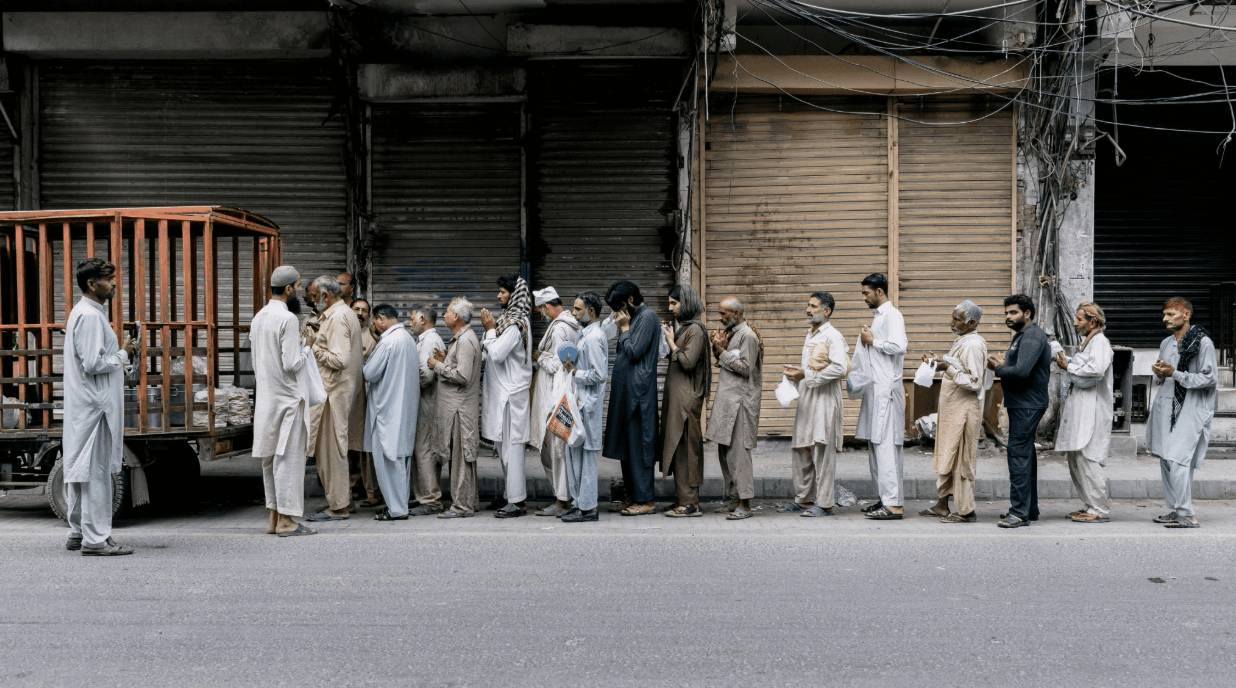
Pakistan collects over Rs. 619 billion ($2.2B USD) in annual Zakat — yet less than half a percent flows through the state. Understanding why reveals as much about trust and religious practice as it does about governance.
Pakistan presents a unique case: a country where the formal state Zakat apparatus collects only a fraction of what is actually given, while an immense informal economy of private, mosque-based, and NGO-mediated giving, operates largely beyond official records.
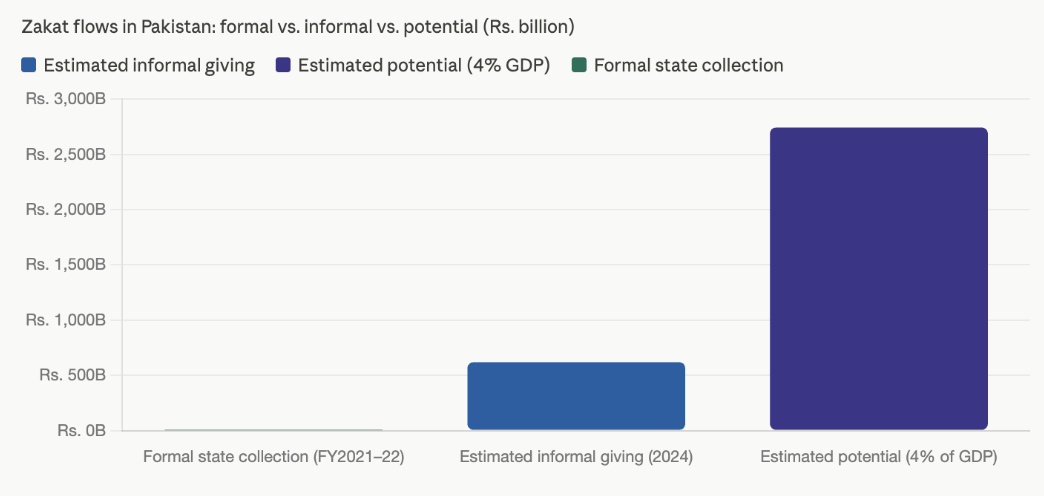
A 2024 survey by the International Centre for Tax and Development (ICTD) and Lahore University of Management Sciences (LUMS) estimates that Sunni Pakistanis pay over Rs. 619 billion (approximately USD $2.19 billion) in Zakat annually, with over 50 million contributors averaging Rs. 15,000 each.[1] Yet in the 2021–22 budget, the formal state fund collected a mere Rs. 2.379 billion — less than one-fiftieth of the total estimated giving.[7]
Estimated annual Zakat giving (2024) | Rs. 619B ($2.19 billion) |
Formal state collection (FY2021–22) | Rs. 2.38B |
Formal as % of total estimated giving | <0.4% |
Pakistan is home to approximately 240 million people, of whom roughly 96% identify as Muslim, making it the world's second-largest Muslim-majority country by population.[3] Against this backdrop, Zakat is a religious obligation and a welfare system operating at a scale that rivals state-administered social protection programs.
"The national state fund collects only a fiftieth of what is estimated to be contributed annually — a structural collapse driven not by low religiosity, but by vanishingly low institutional trust."
Pakistan’s State, Society, and Islamic Finance
Pakistan is also one of the very few Muslim-majority countries to have legislated compulsory Zakat collection at the state level. The system of compulsory collection and distribution began in 1980, with an ordinance by General Muhammad Zia-ul-Haq calling for a 2.5% annual deduction from personal bank accounts on the first day of Ramadan, with revenue directed toward poverty relief.[3]
Pakistan's constitutional basis for Zakat lies in Article 31(C) of the Constitution of the Islamic Republic of Pakistan (1973), which specifies that the State shall endeavor to secure the proper organization of Zakat and Ushr. This gave legal grounding to the most sweeping state intervention in Islamic alms giving in modern history.[3]
Despite this legislation, less than 2% of Zakat givers in Pakistan use the state fund, with most preferring to give directly to individuals, through mosques, schools, and NGOs. A survey conducted by the IBA Centre for Excellence in Islamic Finance revealed that 95% of Muslims in Pakistan prefer donating to Shariah-compliant private organizations over the state system.[4]
The Scale of the System: Potential vs. Reality
As per a report by the Institute of Policy Studies (March 2023), the estimated Zakat collectible annually in Pakistan is more than Rs. 2,743 billion — approximately 4% of GDP, surpassing 28.6% of the government's 2022–23 budget.[13] If collected, this sum could potentially provide Rs. 100,000 to over 27 million individuals.
Legislative and Historical Framework
The Zakat and Ushr (Organisation) Ordinance of 1979 was introduced for the establishment of Zakat organisations at national, provincial, district, sub-district, and local levels. It required banks and financial institutions to deduct 2.5% annually from personal savings accounts on the first day of Ramadan, with collected revenue directed to poverty relief.[3]
The Ordinance immediately provoked significant sectarian conflict. Shia Muslims, following the Ja'fari jurisprudence school, raised strong opposition, and in April 1981 the government granted them exemption through a formal application. This concession created a loophole. Many Sunni Muslims began transferring funds to exempt accounts before Ramadan to avoid the mandatory deduction.
After the 18th Amendment (2010), Zakat and Ushr were devolved to the provinces. Each province enacted its own legislation: Punjab's Punjab Zakat and Ushr Act, 2018; Sindh's 2011 Act; Khyber Pakhtunkhwa's 2011 Act; and Balochistan's 2012 Bill.[6]
Individual Duties: Who Must Pay, and How Much
A Muslim is required to pay Zakat when five conditions are met: being a Muslim; full ownership of the asset; meeting the nisab (minimum wealth threshold); a full Islamic lunar year elapsed since reaching nisab (hawl); and absence from debt that would reduce net assets below nisab.[3]
In Pakistan, the government sets a new nisab annually before Ramadan, usually pegged to either the silver or gold standard. The State Bank of Pakistan set the nisab for Zakat deduction in 2022 at PKR 88,927. By 2024-2025 (1445–46 AH), Punjab updated the nisab to PKR 179,689, reflecting inflation and significant rupee depreciation.[3] Zakat is levied at 2.5% of total net wealth above the nisab after the year (hawl) has elapsed.
Governance Structure
Pakistan's formal Zakat governance operates through a multi-tiered hierarchy — from the federal Ministry of Religious Affairs and the Central Zakat Fund (CZF) at the State Bank of Pakistan, through Provincial Zakat Councils and Departments, down to District and Local Zakat Committees that identify beneficiaries at the mosque and ward level.[4]
The formal system relies entirely on deduction at source by financial institutions. This mechanism has significant structural limitations. It only captures wealth in formal financial accounts. It exempts agricultural income; informal sector earnings; and physical gold, and cash holdings.
Provincial Profiles
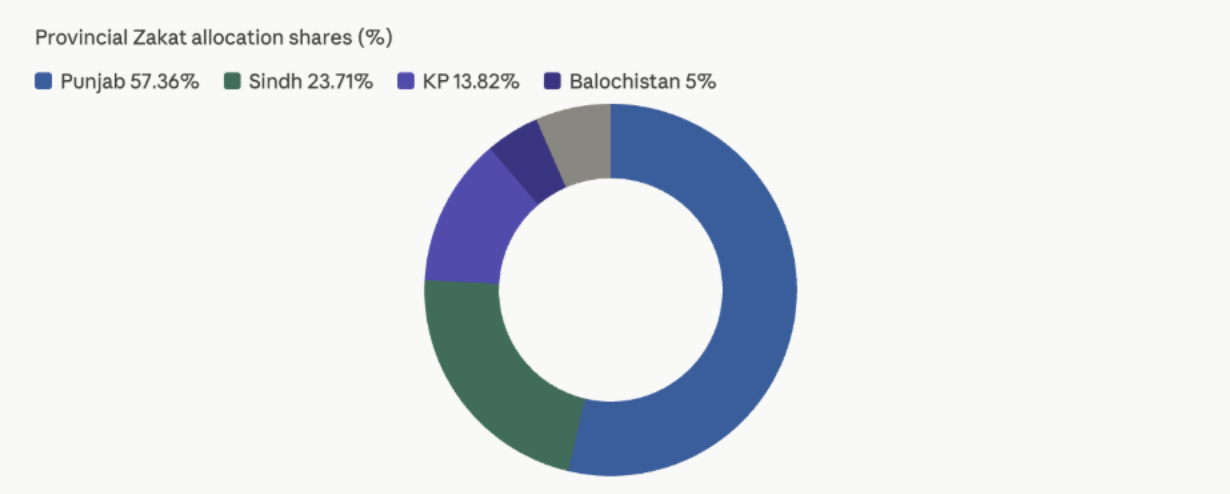
The provincial distribution formula allocates Zakat funds as follows: Punjab receives 57.36%, Sindh 23.71%, Khyber Pakhtunkhwa 13.82%, and Balochistan 5% of the total provincial share. The formula is population-weighted and has remained largely unchanged since the pre-2008 period, despite significant demographic and economic shifts.[6]
Province | Allocation | Key challenge |
Punjab | 57.36% | Low stipend rates (historically PKR 500/month); political interference in beneficiary selection |
Sindh | 23.71% | Only 23% of available funds released to district committees in FY2022–23; audit failures[8] |
Khyber Pakhtunkhwa | 13.82% | Conflict legacy in border districts; large informal economy; low banking penetration |
Balochistan | 5.00% | Geographic isolation; nomadic communities unreachable; lowest formal banking penetration |
Federal (ICT, GB) | 7.00% | Small territory, limited poverty focus |
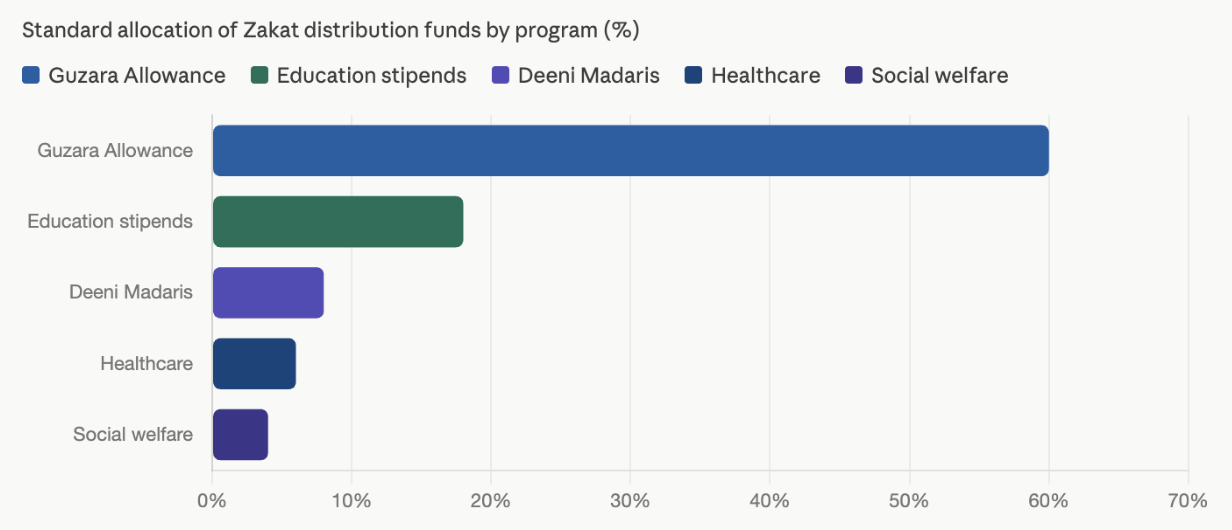
Punjab is Pakistan's most populous province and receives the largest provincial allocation. Zakat funds are deployed across several programs: the Guzara Allowance (approximately 60% of total allocation), Educational Stipends (18%), grants to Deeni Madaris (8%), Healthcare (6%), and Social Welfare and Rehabilitation (4%).[2]
Balochistan receives the smallest share despite some of Pakistan's highest poverty rates and most acute geographic dispersion challenges. The province suffers from near-total reliance on mosque-based and informal collection, with an almost entirely agricultural and pastoral economy where nisab-eligible wealth rarely passes through the banking system.[6]
Distribution Mechanisms and Program Design
The Guzara Allowance is the centerpiece of Pakistan's formal Zakat distribution by providing a monthly cash grant to the chronically poor (mustahiqeen). Its historical rate of PKR 500 per month has drawn widespread criticism for being far too low in light of rising inflation and the cost of living .[2]
Zakat-funded educational stipends support deserving students in government schools, colleges, and Deeni Madaris (Islamic seminaries). Including Deeni Madaris as recipients has helped sustain public support, but it has also raised concerns about oversight and transparency. . Academic research using KP Zakat department data and PSLM survey data confirmed that Zakat spending in education reduces barriers to schooling.[14]
Health care assistance offers relief to poor patients who cannot afford treatment. This is typically done through referrals from District Zakat Committees to designated government hospitals. The Marriage Grant provides financial support to unmarried women whose guardians cannot cover wedding expenses; its current amount is PKR 20,000.[2]
Challenges: Why Pakistan's Formal System Underperforms
The most fundamental challenge is widespread loss of public trust in the state's capacity to manage Zakat. The government administered system is overshadowed by political interventions, unclear procedures for recipients , inadequate public disclosures, weaker audits and controls, and the absence of professional Zakat managers.[4]
Zakat Councils and their funds have become a source of political and economic power, with Pakistani political parties competing over control of the councils. This politicization has compromised the integrity of beneficiary lists and diverted funds toward political patronage rather than targeting genuine poverty.
The conversion of a voluntary religious act into a compulsory government tax created a theological legitimacy problem from the start. Many Sunni Muslims felt that paying a government tax did not satisfy their personal religious obligation, leading them to pay Zakat separately through private channels — effectively giving twice, which is avoided by creative banking.[6]
In Sindh, only 23% of available funds were released to District Zakat Committees and institutions in FY2022–23 — meaning 77% of collected Zakat sat undistributed for the year, a distribution backlog far more severe than comparative dysfunction seen in other systems.[8]
A major challenge is that the bank deduction mechanism structurally excludes large portions of the Pakistani economy: informal sector workers with no savings accounts, and agricultural communities are largely exempt or outside the formal banking system. Also outside this system are the owners of gold, both jewelry and investments, participants of the cash economy, and Zakat sent directly by overseas Pakistanis to family members. The latter amounts to a significant amount which bypasses all systems.
The Informal Sector: NGOs, Mosques, and Direct Giving
Beyond the formal state system, NGOs, welfare foundations, trusts, and hospitals also collect Zakat. These funds are used for programs such as interest-free loans, education, skill development, and healthcare. Organizations such as The Citizens Foundation (TCF), Edhi Foundation, Akhuwat, and Shaukat Khanum Memorial Trust enjoy widespread confidence among the population and are now under government oversight due to FATF (Financial Action Task Force) regulations, even though data on their Zakat collections is not publicly available.[4]
The informal giving landscape consists of three primary channels: direct individual giving — the dominant mode, where donors give to identified recipients such as family members, neighbors, or known individuals; mosque and madrassa networks where imams collect and distribute locally; and NGOs and welfare trusts operating at scale.
Zakat Culture and Religious Practice
Ramadan functions as the primary giving season in Pakistan, with the majority of annual Zakat disbursed in the month before Eid al-Fitr. Women are disproportionately represented as recipients across all channels. Family-centered giving — where Zakat flows to known relatives, neighbors, or community members rather than anonymous beneficiaries — dominates over institutional forms. The diaspora dimension is also significant: overseas Pakistanis send substantial Zakat remittances directly to family members, further bypassing formal systems.
The Larger Question
Pakistan's Zakat challenge is, at its core, a legitimacy crisis rather than a compliance crisis. Pakistanis give generously, faithfully, and at extraordinary scale. What they do not do is trust the state to steward that giving. A review of the financial statements of some NGOs in Pakistan revealed that their investment of Zakat and charity funds is not always Shariah-compliant; some have invested funds in interest-based avenues and government interest-based bonds, a practice contrary to Islamic principles and undermining their own credibility as alternatives.[4]
As in Malaysia, the deeper question is whether Zakat can be properly understood as a pillar of faith to improve the human condition, as an instrument of development, security, and human dignity, rather than being reduced to either a tax or a form of charity. Pakistan's potential of Rs. 2,743 billion annually remains largely untapped, not because the obligation is unfelt, but because the institutions designed to channel it have failed to earn the trust of those who give.[13]
Structural reforms including independent Zakat management, digital payment infrastructure, transparent beneficiary registries, and the decoupling of Zakat administration from party politics, offer a path forward. The scale of informal giving demonstrates that the religious will exists. The state's task is to build institutions worthy of it.
References
[1] Gallien, M., & Javed, U. (2025, March 26). Pakistanis are paying over 1.7 billion GBP in Zakat every year — mostly to women. ICTD. https://www.ictd.ac/blog/pakistanis-zakat-every-year-women/
[2] Government of Punjab. (2024). Overview: Zakat & Ushr Department. https://zakat.punjab.gov.pk/overview
[3] Government of Pakistan. (1980). The Zakat and Ushr Ordinance, 1980 (XVIII of 1980). Ministry of Religious Affairs.
[4] ISSRA. (2024). Zakat collection and distribution system in Pakistan. https://issra.pk/pub/insight/2024/
[5] Government of Khyber Pakhtunkhwa. (2023). Zakat & Ushr Department overview. https://zakat_ushr.kp.gov.pk/
[6] Samra, U., & Siddiqui, M. S. (2021). System of Zakat and Ushr — A paradigm shift after the eighteenth amendment. Journal of Islamic Thought and Civilization, 11(1), 411–420.
[7] Express Tribune. (2024, March 30). Here's how much Pakistanis pay in Zakat each year. https://tribune.com.pk/story/2537257/
[8] Auditor General of Pakistan. (2025). Audit report on the accounts of Provincial Zakat Fund and District Zakat Committees, Sindh, Audit Year 2024–25.
[9] World Bank. (2023). Global poverty and inequality platform: Pakistan.
[10] World Bank. (2025, September). Pakistan's poverty trajectory: Progress, peril, and the path forward.
[11] BISP / Government of Pakistan. (n.d.). Social safety nets program description: Pakistan Bait-ul-Maal.
[12] Institute of Policy Studies. (2023). Estimated Zakat collectible annually in Pakistan. Islamabad: IPS.
[13] Express Tribune. (2024, February 26). Maximising Zakat's impact on economy. https://tribune.com.pk/story/2457592/
[14] Wiley / Asia Social Work and Policy Review. (2025, January 29). Zakat and sustainable development goals: Assessing the ripple effect of obligatory-alms spending on education.
If you found this article informative & would like to support further research, click here to donate!
