





As a follow-up to our last article on Muslim-majority countries and their GDP, this article focuses on global muslim GDP across the entire planet - from Muslim-majority countries to countries where Muslims live as a minority.
Islam is the world's second-largest religion and, by a wide margin, its fastest-growing major faith. As of the most recent authoritative count — Pew Research Center's 2020 baseline, published in its June 2025 report — there were approximately 2.0 billion Muslims worldwide, representing 25.6% of the global population of roughly 7.8 billion people. (Pew Research Center, "How the Global Religious Landscape Changed From 2010 to 2020," June 2025)
That 2020 count is the most recent point-in-time estimate for which Pew has directly modeled data from over 2,700 censuses, surveys, and population registers across 201 countries and territories — as opposed to a forward projection. This article uses that 2020 dataset as its statistical backbone, since it is both the newest and the most methodologically rigorous cross-country religious dataset available, and layers in current (2024–25) total population figures to show today's Muslim-vs-non-Muslim splits by continent. By that measure, our estimates on population and GDP will be conservative in this report. Also, with respect to Muslim population in Muslim minority countries, the census tends to undercount Muslim population.
How many Muslims are there, and how fast is the population growing?
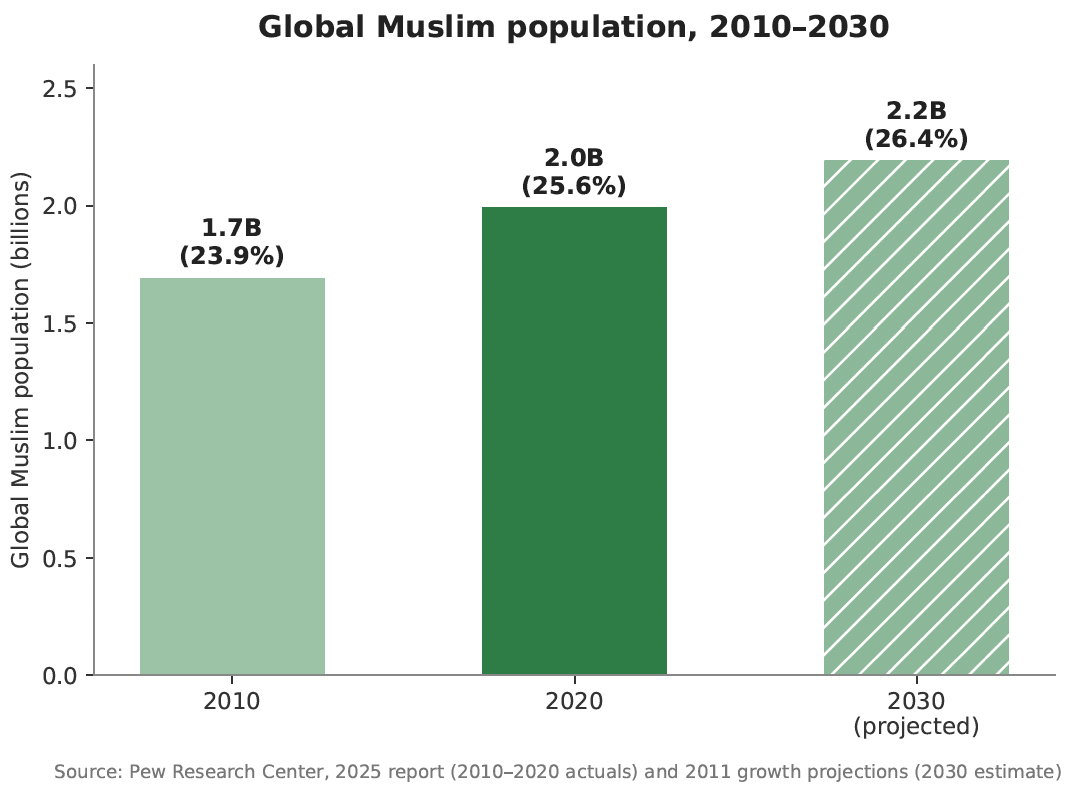
Between 2010 and 2020, the number of Muslims worldwide grew 21%, from about 1.7 billion to 2.0 billion — twice the 10% growth rate of the rest of the world's population over the same decade. Muslims added roughly 347 million people in that decade, more than every other religious group combined. (Pew Research Center, 2025)
As a result, the Muslim share of the global population rose from 23.9% in 2010 to 25.6% in 2020. Earlier Pew growth projections — dating to 2011 and still the most-cited long-range figures — put the global Muslim population at approximately 2.2 billion (about 26–27% of the world) by 2030, and near-parity with Christians (around 2.8 billion each, roughly 30% of the world) by 2050. (Pew Research Center projections, 2011 and 2015)
The growth is driven almost entirely by demographics, not conversion. Muslim women have an average of roughly 2.9–3.1 children, above the global replacement rate, and the Muslim population skews younger than the world average — both of which compound into faster natural increase. Net religious conversion into or out of Islam is close to zero at the global level, since roughly as many people leave Islam as join it worldwide.
Where Muslims fit in the global religious landscape
In 2020, Christians remained the largest religious group at 28.8% of the world (about 2.3 billion people), followed by Muslims at 25.6% (2.0 billion), the religiously unaffiliated at 24.2% (1.9 billion), Hindus at 14.9% (1.2 billion), Buddhists at 4.1% (roughly 300 million), other religions combined at 2.2% (about 200 million), and Jews at 0.2% (around 10–15 million). (Pew Research Center, 2025)
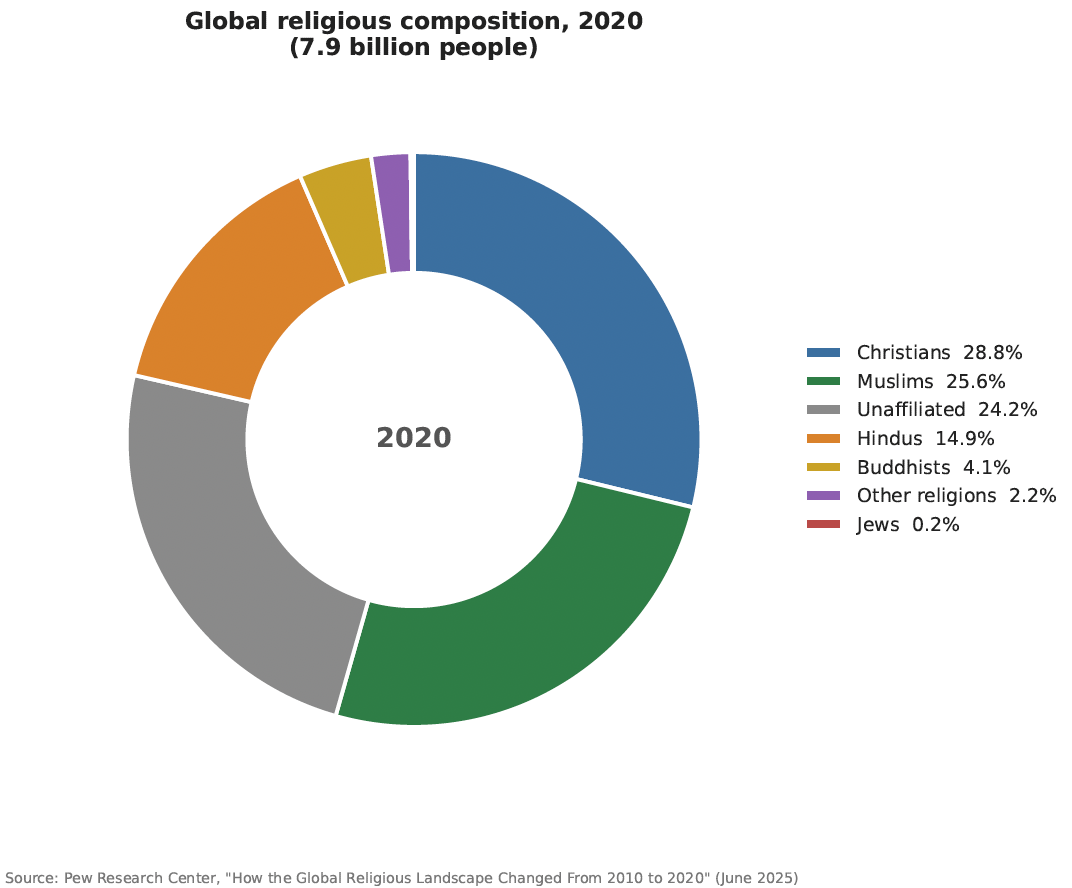
Christianity's share of the world declined from 30.6% to 28.8% over the decade, driven mainly by losses in Europe and the Americas, while Islam's share rose and the unaffiliated category also grew substantially. Buddhism was the only major group to shrink in absolute numbers, reflecting low fertility and aging populations in East Asia.
Where in the world do Muslims live?
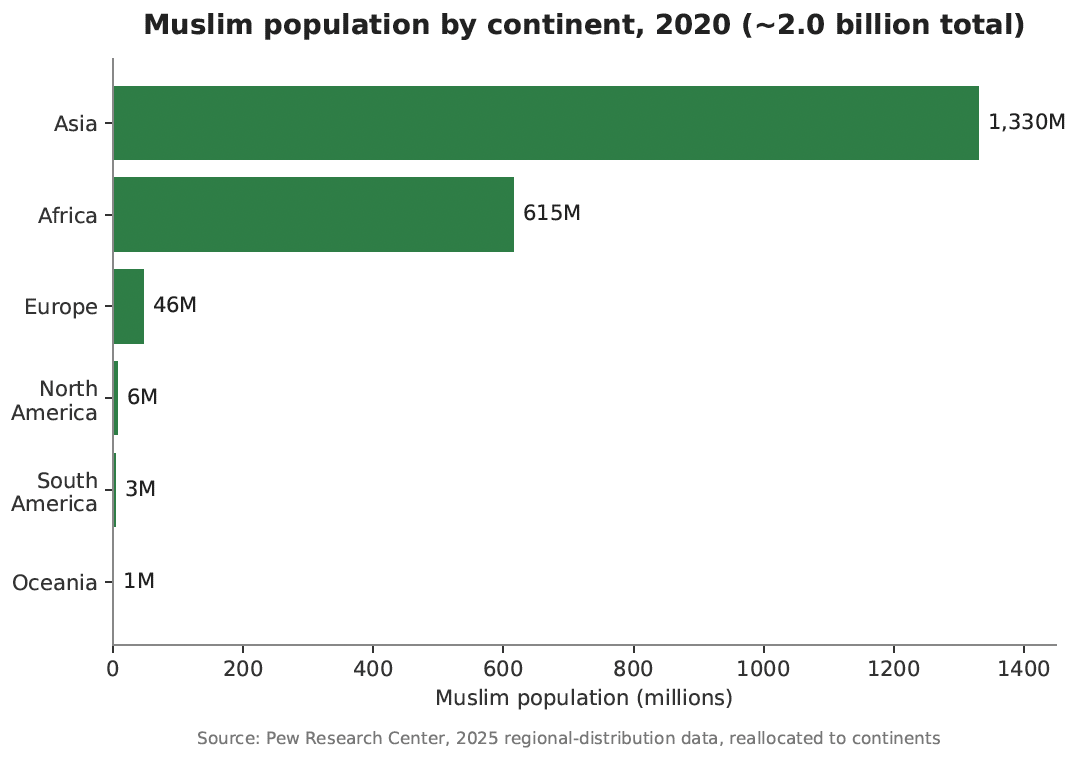
Muslims live on every inhabited continent, but their distribution is heavily concentrated in Asia and Africa. Roughly 59% of the world's Muslims live in the broad Asia-Pacific region (dominated by South and Southeast Asia), about 20% live in the Middle East-North Africa region, and about 18% live in sub-Saharan Africa — a share that has grown since 2010. Reallocated onto a standard six-continent map, this puts roughly two-thirds of the world's Muslims in Asia and just under a third in Africa, with Europe, North America, South America, and Oceania together accounting for the remaining 3%. (Pew Research Center, 2025)
Muslim vs. non-Muslim population, by continent
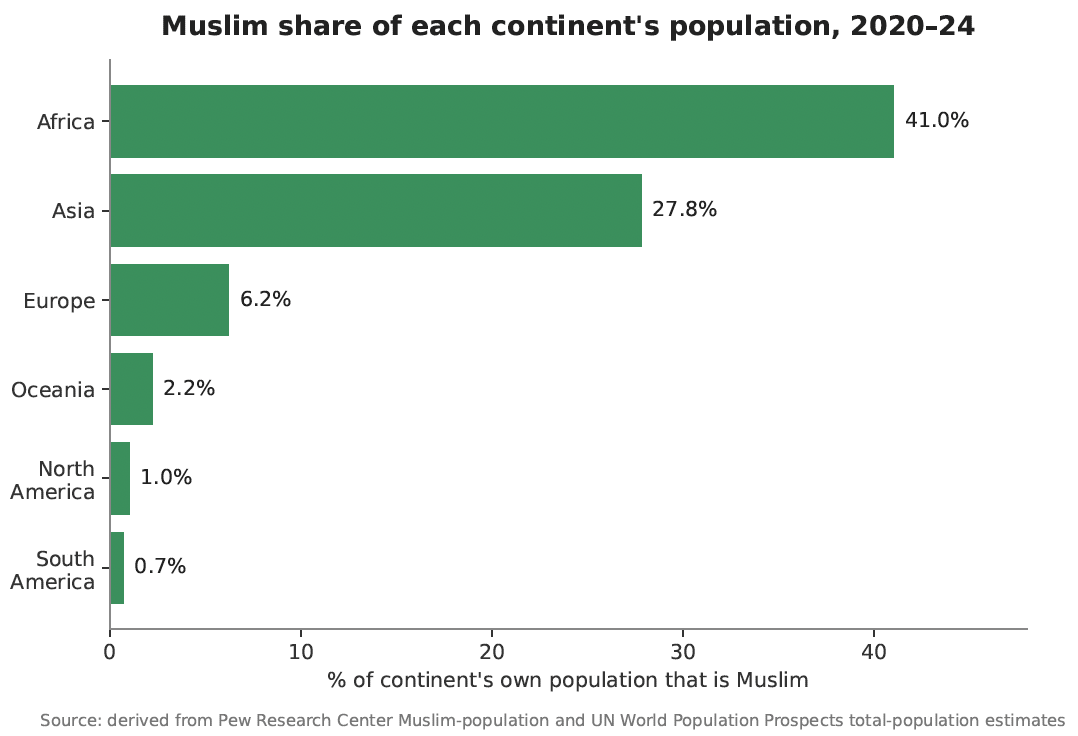
Because Africa and Asia are also the world's most populous continents, a country- or continent-level count alone doesn't show how large the Muslim share actually is relative to everyone else living there. The chart below sets each continent's Muslim population against its total population (current, 2024–25 estimates) to show both sides of that comparison at once.
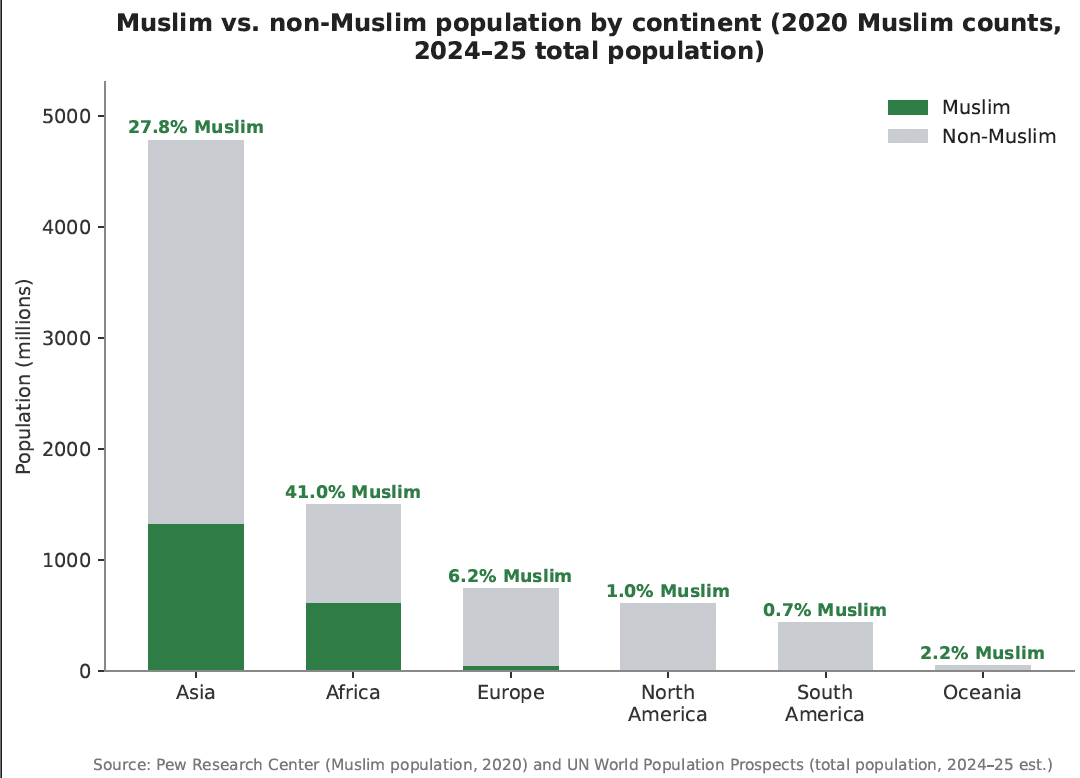
Africa has the highest Muslim share of any continent at roughly 41% of its own population — pulled up by North Africa's near-total Muslim countries and West Africa's large Muslim-majority states. Asia follows at around 28%, driven by the sheer size of South and Southeast Asia even though Islam is a minority faith across the continent as a whole. Europe sits at about 6%, while North America, South America, and Oceania are all under 3%.
Muslim-majority vs. Muslim-minority countries: most Muslims live where Islam is the majority faith
A different way to cut the same population answers a question the continent table can’t: of the world’s ~1.98 billion Muslims, how many live somewhere Islam is the majority religion, versus how many live as a religious minority within their own country? Building this bottom-up from the top-50+ country list (summing every country at or above 50% Muslim share against everyone else) rather than assuming a round number gives a clear answer: roughly 1.54 billion Muslims (about 78%) live in a Muslim-majority country, and about 440 million (22%) live as a minority in a Muslim-minority country.
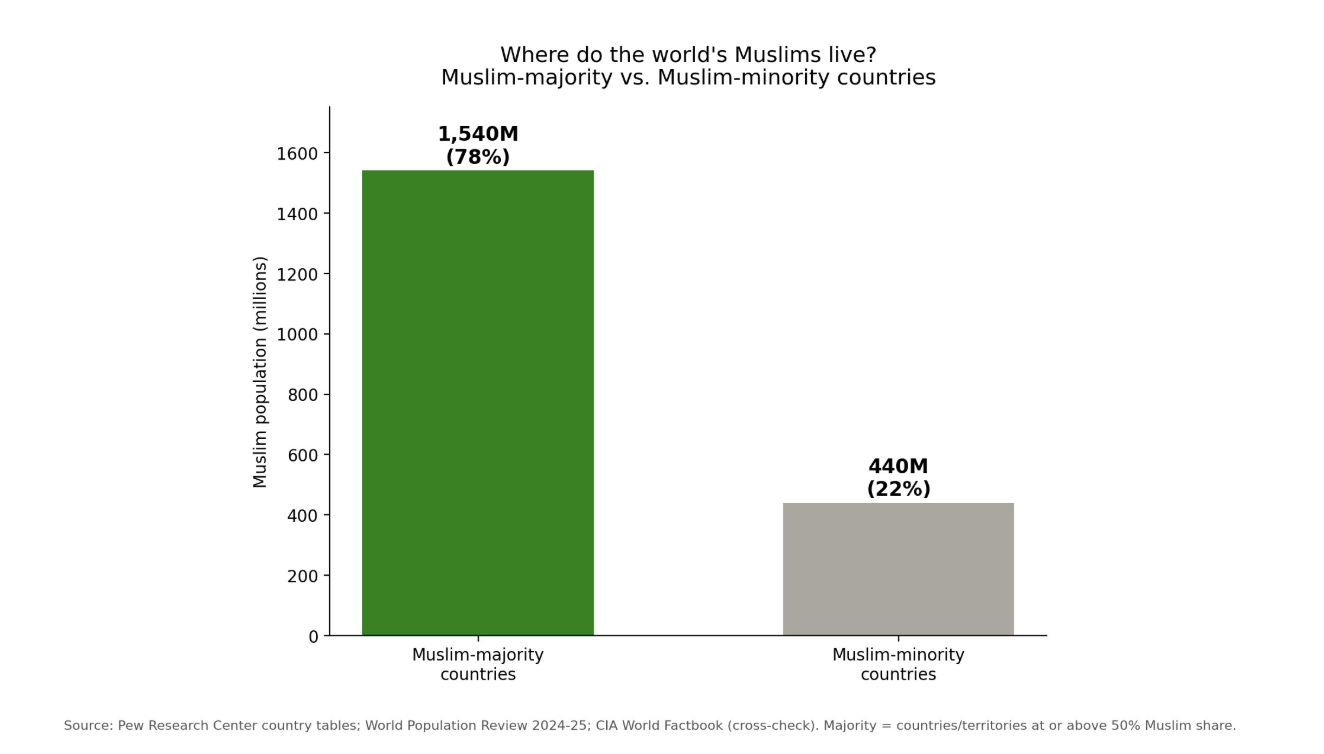
The nearly 4-to-1 ratio here is a useful corrective to two opposite misconceptions. It’s not the case that most Muslims are a scattered global diaspora living as minorities (only about 1 in 5 are); but it’s also not the case that Islam is exclusively a majority-context religion — 440 million people, more than the entire population of the United States plus Canada, practice Islam as a minority faith within their own country. India alone (~200M) accounts for nearly half of that 440 million minority-context total, which means the “Muslim minority” category is itself dominated by a single country’s population dynamics rather than being evenly spread across many nations.
Splitting the majority-country total further by continent shows how concentrated it is even within the “majority” category:
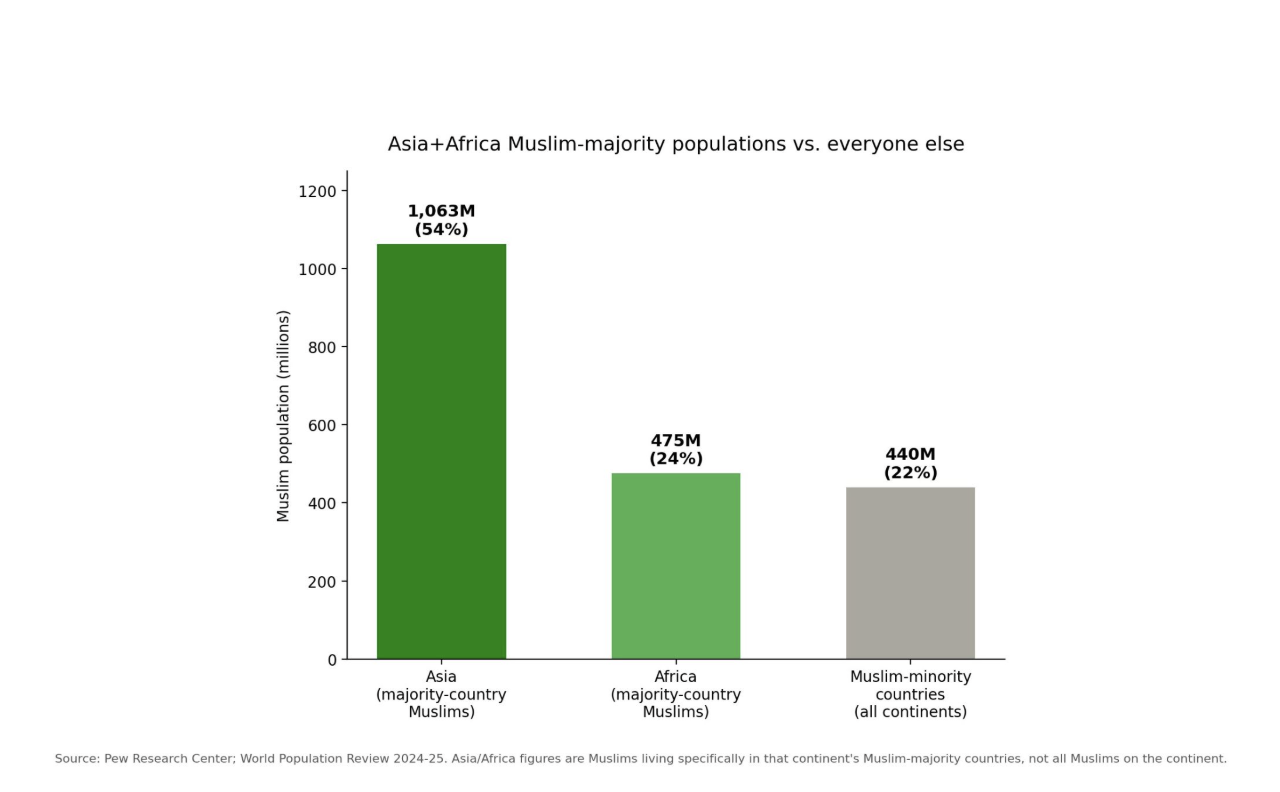
Asia’s Muslim-majority countries alone (Indonesia, Pakistan, Bangladesh, Iran, Turkey, the Central Asian republics, and the Gulf states) hold 1.06 billion people — 54% of all Muslims worldwide, and more than double Africa’s Muslim-majority total (475M, 24%). The Muslim-minority category (440M, 22%) is close in size to Africa’s entire majority-country population, which is a useful scale check: the population of Muslims living as a minority anywhere in the world is roughly comparable to the population of Muslims living in every Muslim-majority African country combined.
The countries with the most Muslims
A third of the world's Muslims live in just three countries: Indonesia, Pakistan, and India. Indonesia has the largest single Muslim population of any country — about 239 million people, or 12% of all Muslims worldwide — narrowly ahead of Pakistan (227 million) and India (213 million). India is notable as the largest Muslim population living as a religious minority: its roughly 213 million Muslims make up about 15% of India's population. (Pew Research Center, 2025)
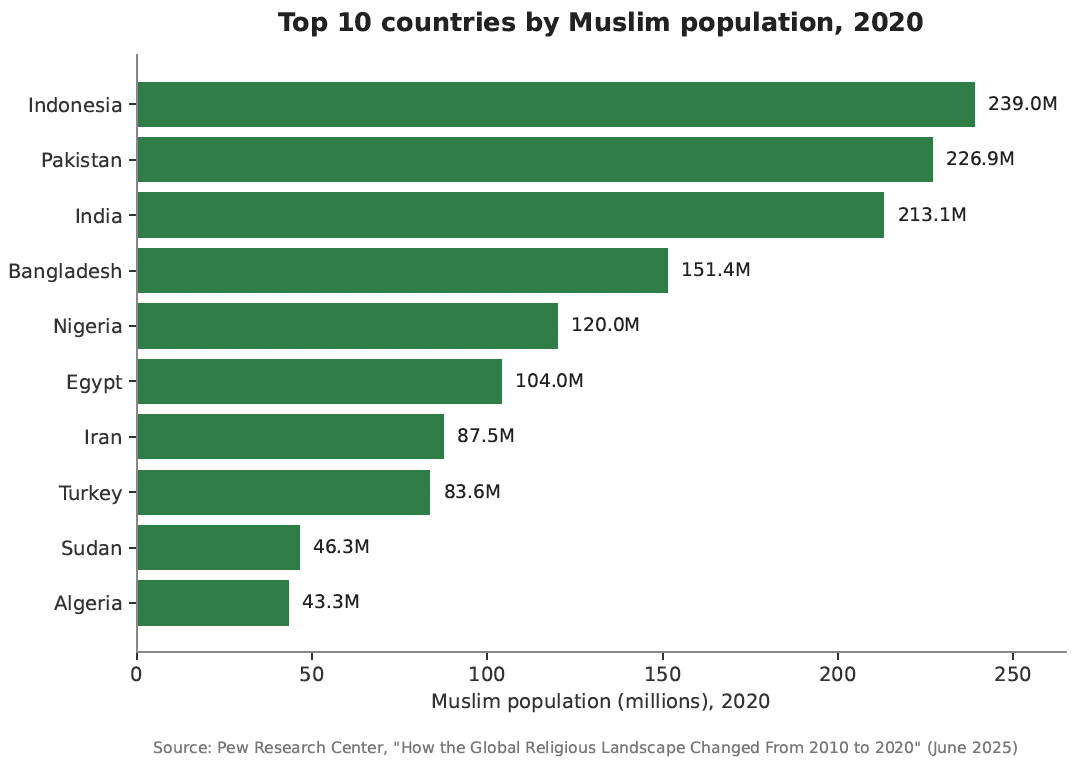
Collectively, the 10 countries with the largest Muslim populations are home to about 1.3 billion Muslims — roughly 65% of the global total. In nine of these 10 countries, Islam is the majority religion; India is the sole exception.
Rank | Country | Muslim population (2020) | Muslim share of country |
1 | Indonesia | 239.0M | ~87% |
2 | Pakistan | 226.9M | ~96% |
3 | India | 213.1M | ~15% |
4 | Bangladesh | 151.4M | ~91% |
5 | Nigeria | 120.0M | ~51% |
6 | Egypt | 104.0M | ~95% |
7 | Iran | 87.5M | ~99% |
8 | Turkey | 83.6M | ~99% |
9 | Sudan | 46.3M | ~91% |
10 | Algeria | 43.3M | ~99% |
Table 1. Top 10 countries by Muslim population. Figures are Pew Research Center's 2020 estimates, the most recent point-year for which Pew has published a full country-level dataset; several countries below the top 10 (notably Nigeria, China, and Russia) have wider uncertainty ranges because they do not ask about religion on their national census.
Muslim-majority countries and territories
Islam is the majority religion (over 50% of the population) in roughly 50 countries and territories, concentrated in five regions:
● North Africa (6): Morocco, Algeria, Tunisia, Libya, Egypt, Western Sahara — nearly all 90%+ Muslim.
● Middle East (14): Turkey, Syria, Iraq, Jordan, Lebanon, Saudi Arabia, Yemen, Oman, UAE, Qatar, Kuwait, Bahrain, Iran, and the Palestinian territories.
● Central and South Asia (7): Afghanistan, Pakistan, Tajikistan, Uzbekistan, Turkmenistan, Kyrgyzstan, and Kazakhstan (~70%, sometimes classified as majority-minority).
● Southeast Asia (3): Indonesia, Malaysia, Brunei.
● Sub-Saharan Africa (~17): Somalia, Djibouti, Mauritania, Senegal, Gambia, Guinea, Mali, Niger, Chad, Sudan, Sierra Leone, Comoros, Burkina Faso (~64%), and Nigeria (~51%, a contested figure — some counts place it below 50%).
A handful of Southeastern European countries also cross the threshold: Kosovo (~93%), Bosnia and Herzegovina (~51%), and Albania (~56%). Countries that sit close to the 50% line — Nigeria, Bosnia, Kazakhstan, and Chad among them — show meaningful disagreement between Pew, national censuses, and other compilers, and are best treated as ranges rather than fixed points.
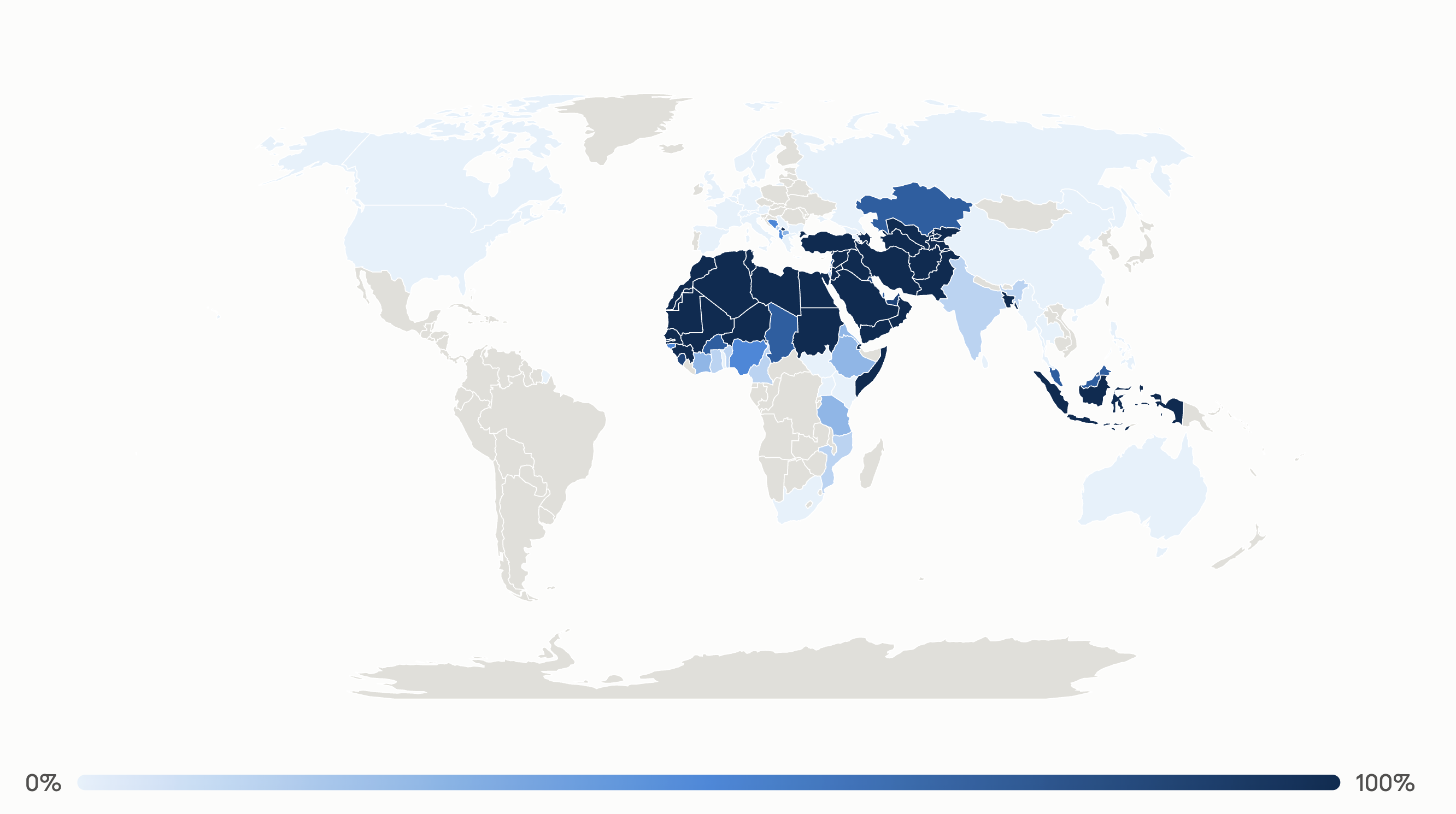
World map: darkest shading runs through North Africa, the Middle East, Central/South Asia, and Indonesia, where Muslims form 90–99%+ of the population (Morocco, Afghanistan, Pakistan, Iran, Somalia, Indonesia, etc.). Sub-Saharan countries like Nigeria (~50%) and Chad (~58%) sit in the mid-range, while Western Europe, the Americas, and East Asia stay light blue, generally under 10%.
Muslims in the United States
Muslims remain a small share of the U.S. population — about 1% of American adults, or roughly 3.5–4.5 million people, according to Pew's 2023–24 Religious Landscape Study, the largest recent U.S. religion survey (about 37,000 respondents). Pew's long-range projections put U.S. Muslims at around 2.1% of the population by 2050, which would make Islam roughly as common in America as Judaism is today. (Pew Research Center, 2023–24 Religious Landscape Study; Pew 2011 growth projections)
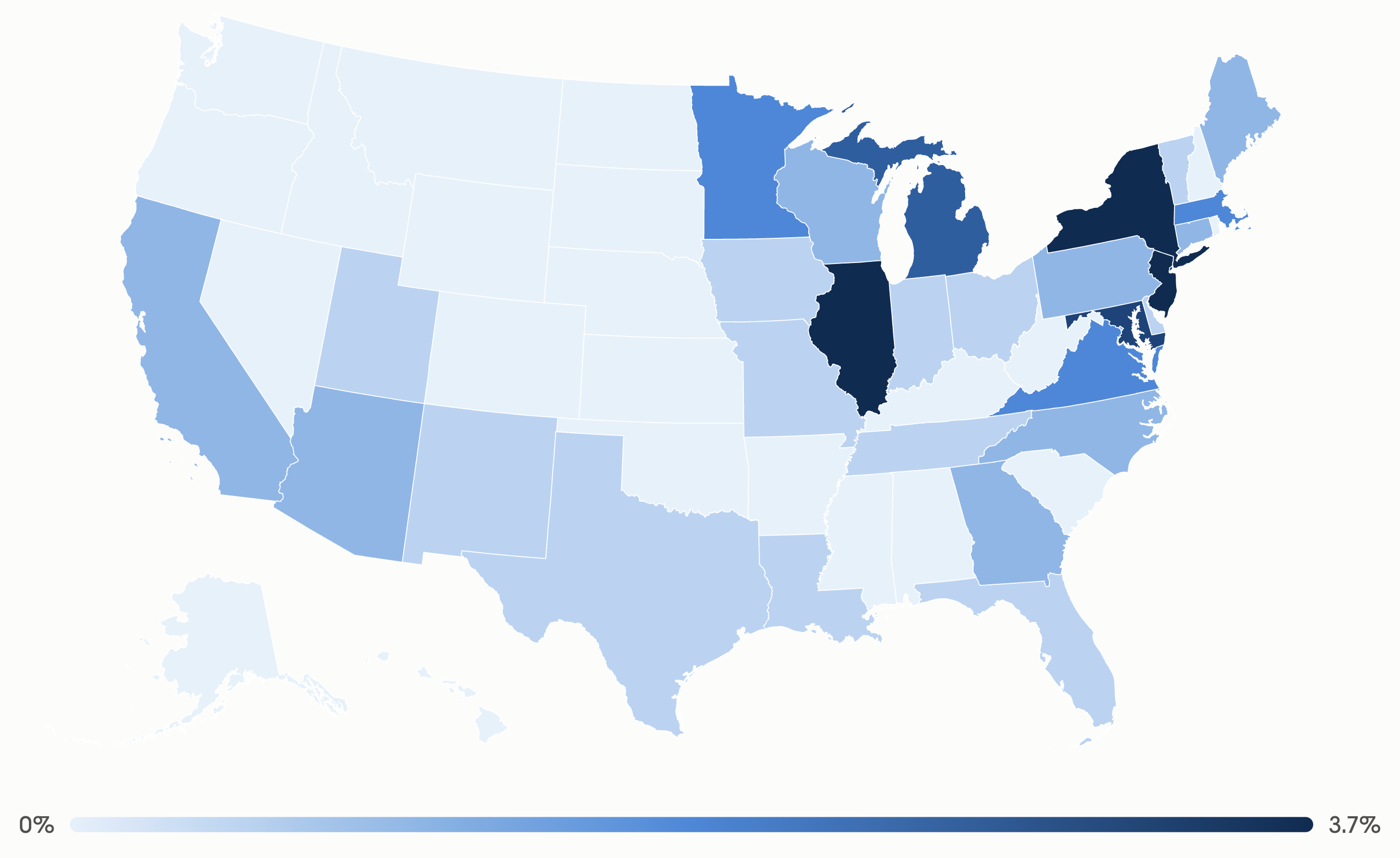
Within the U.S., estimated Muslim population share is highest in states with large immigrant and refugee communities: Illinois (Chicago metro), New York and New Jersey (the NY/NJ corridor), Maryland (D.C. suburbs), Michigan (Dearborn's Arab-American community), and Minnesota (Somali resettlement in the Minneapolis area). State-level religion estimates carry wide margins of error due to small sample sizes and should be read as approximate rankings rather than precise figures.
US map: the deepest states are Illinois (3.71%), New York (3.62%), New Jersey (3.34%), Maryland (2.99%), and Michigan (2.37%) — driven by Chicago, the NY/NJ metro corridor, the DC suburbs, and Dearborn's long-established Arab-American community. Minnesota (1.96%) stands out from its Midwest neighbors due to Somali refugee resettlement in Minneapolis. Most of the South, Great Plains, and Mountain West stay under 0.5%.
Europe: a small but fast-growing and unevenly distributed Muslim population
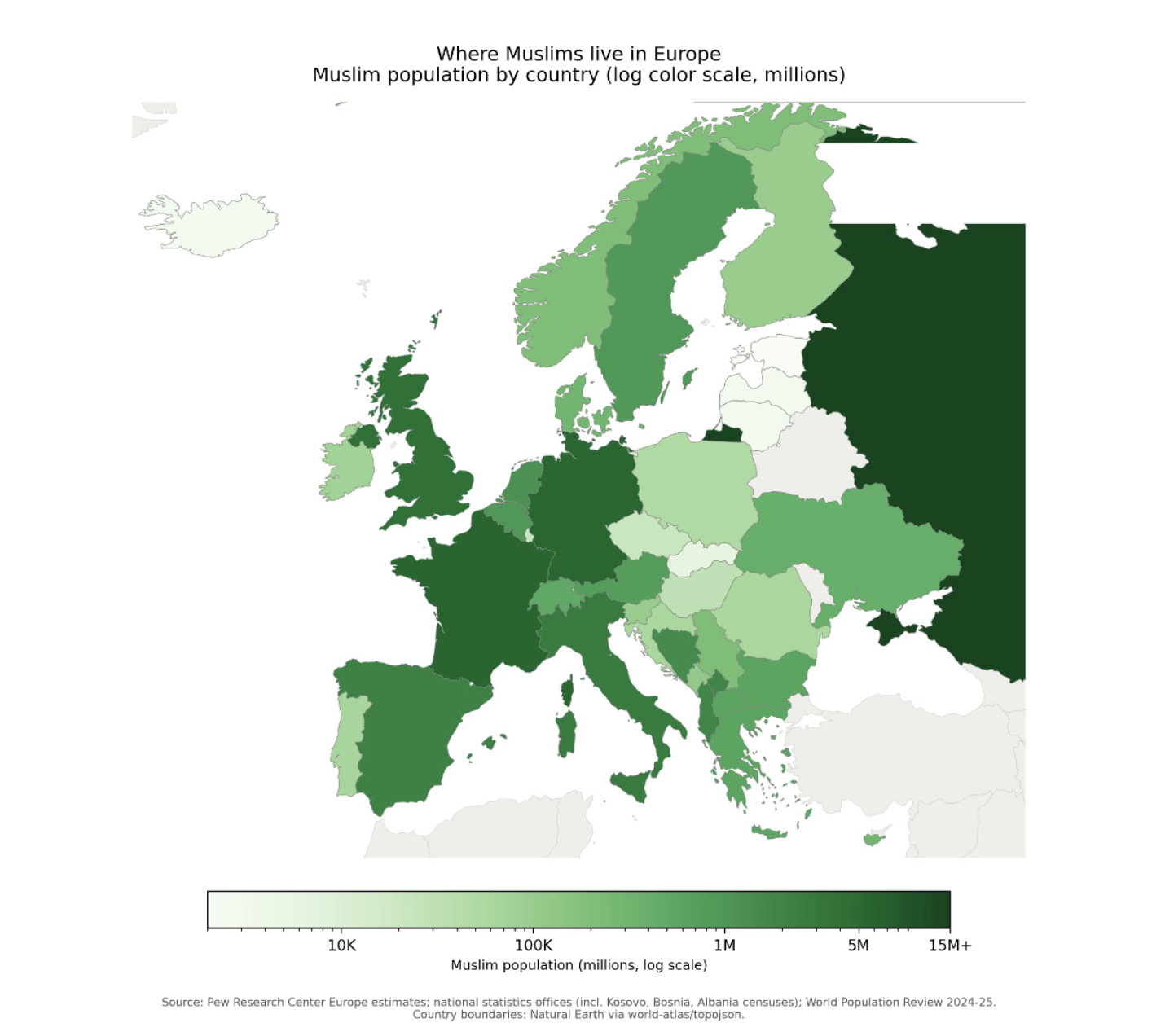
Europe holds an estimated 46 million Muslims, about 6.2% of the continent’s population — small in global terms (2.3% of the world’s Muslims) but the fastest-growing religious minority in most Western European countries, driven by post-war labor migration, colonial-era migration, and more recent refugee movements rather than by higher birth rates alone.
The distribution across European countries is as uneven as the US state breakdown, split between two very different patterns: large Western European countries with a few million Muslims each (a small percentage of a very large population), and Southeastern European countries where Muslims are a historic majority or near-majority dating back centuries to Ottoman rule, not a recent migration story.
Country | Est. Muslim population | Est. share of country | Primary driver |
Russia (European part) | ~15M | ~11-14% | Historic Tatar, Caucasus, and Central Asian populations |
France | ~5.7M | ~8.8% | North African (Maghreb) postcolonial migration |
Germany | ~5.5M | ~6.6% | Turkish guest-worker migration from the 1960s; recent Syrian refugee resettlement |
United Kingdom | ~4.1M | ~6.3% | South Asian (Pakistani, Bangladeshi) postcolonial migration |
Kosovo | ~1.8M | ~93% | Historic Ottoman-era Muslim majority |
Italy | ~2.7M | ~4.5% | North African and Balkan migration |
Albania | ~1.9M | ~56% | Historic Ottoman-era Muslim majority |
Spain | ~2.1M | ~4.4% | Moroccan migration |
Bosnia and Herzegovina | ~1.5M | ~51% | Historic Ottoman-era Muslim majority (Bosniaks) |
Netherlands | ~1.2M | ~7.1% | Turkish and Moroccan migration |
Sources: Pew Research Center Europe estimates; national statistics offices (Kosovo, Bosnia, and Albania each collect religion data via census); World Population Review 2024-25 compilation.
Muslims in Canada
Canada is home to one of the fastest-growing Muslim populations among Western democracies. According to Statistics Canada's 2021 Census of Population, roughly 1.8 million Canadians identify as Muslim, or about 4.9% of the national population — up from 3.2% in 2011 and less than 1% in 1991. Islam is Canada's second-largest religion after Christianity and is projected by Pew Research Center's long-range models to reach approximately 6.5-7% of the population by 2030 and continue rising through mid-century, driven mainly by immigration and, secondarily, higher fertility. The population is concentrated in Ontario and Quebec. Ontario alone accounts for roughly half of all Canadian Muslims, centered on the Greater Toronto Area, while Quebec's Muslim population is concentrated in Montreal. Alberta (Calgary and Edmonton) and British Columbia (Vancouver) host smaller but growing communities.
Migration streams are diverse, drawing from South Asia, the Arab world, sub-Saharan Africa (notably Somali-Canadian communities), and Southeast Asia, making Canada's Muslim population more ethnically varied than in most European countries, where migration has tended to trace back to a smaller number of former colonial or guest-worker source countries.
Metric | Value |
Muslim population (2021 Census) | ~1,775,700 (~4.9% of Canada) |
Share in 2011 / 1991 | 3.2% / <1% |
Largest provincial populations | Ontario, Quebec |
Key metro areas | Toronto, Montreal, Calgary, Edmonton, Vancouver |
Pew long-range projection (~2030) | ~6.5-7% of population |
Source: Statistics Canada, 2021 Census of Population; Pew Research Center projections.
Economic Footprint: GDP Attributable to Muslim-Minority Populations
Estimated GDP by country/region
Country / Region | Approx. GDP (nominal,US$) | Muslim share | Est. GDP attributable toMuslim population |
USA | $28.8 trillion | ~1.1% | ~$317 billion |
Canada | $2.1 trillion | ~4.9% | ~$105 billion |
France | $3.1 trillion | ~8.8% | ~$273 billion |
Germany | $4.7 trillion | ~6.6% | ~$310 billion |
United Kingdom | $3.5 trillion | ~6.3% | ~$221 billion |
Italy | $2.4 trillion | ~4.5% | ~$108 billion |
Spain | $1.6 trillion | ~4.4% | ~$70 billion |
Netherlands | $1.1 trillion | ~7.1% | ~$78 billion |
Russia | $2.2 trillion | ~12% (mid of 11-14% range) | ~$264 billion |
China | $18.8 trillion | ~1.7% | ~$320 billion |
India | $3.9 trillion | ~15% | ~$585 billion |
Africa (Muslim-minority countries only)* | ~$1.6 trillion (subset) | ~17% blended | ~$270 billion |
Africa: figure excludes the ~20 Muslim-majority African countries/territories already listed earlier (Morocco, Algeria, Egypt, Nigeria, Sudan, Senegal, etc.), whose entire GDP is captured in the majority-country total below. This row estimates only the GDP linked to Muslims living as a religious minority elsewhere on the continent (e.g. Ethiopia, Tanzania, Kenya, Uganda, DRC, South Africa, Ghana, Mozambique) — roughly 140 million people out of an estimated minority-context African population of ~840 million.
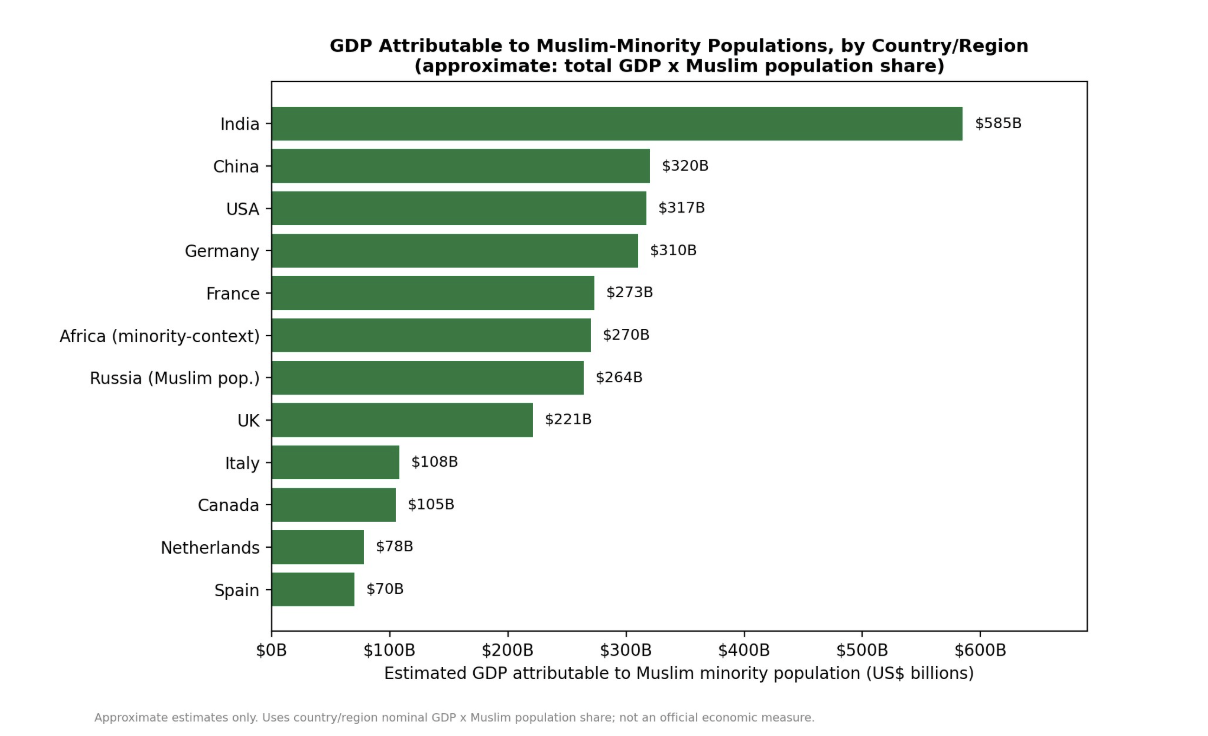
Summed across the countries/regions above, an estimated ~$2.92 trillion in annual GDP is attributable to Muslims living as a religious minority worldwide — before counting minority Muslim populations in other countries not itemized here (e.g. the Philippines, Thailand, Myanmar, Ethiopia's full total, or Israel).
Muslim-Majority Countries vs. Muslim-Minority Populations: GDP Comparison
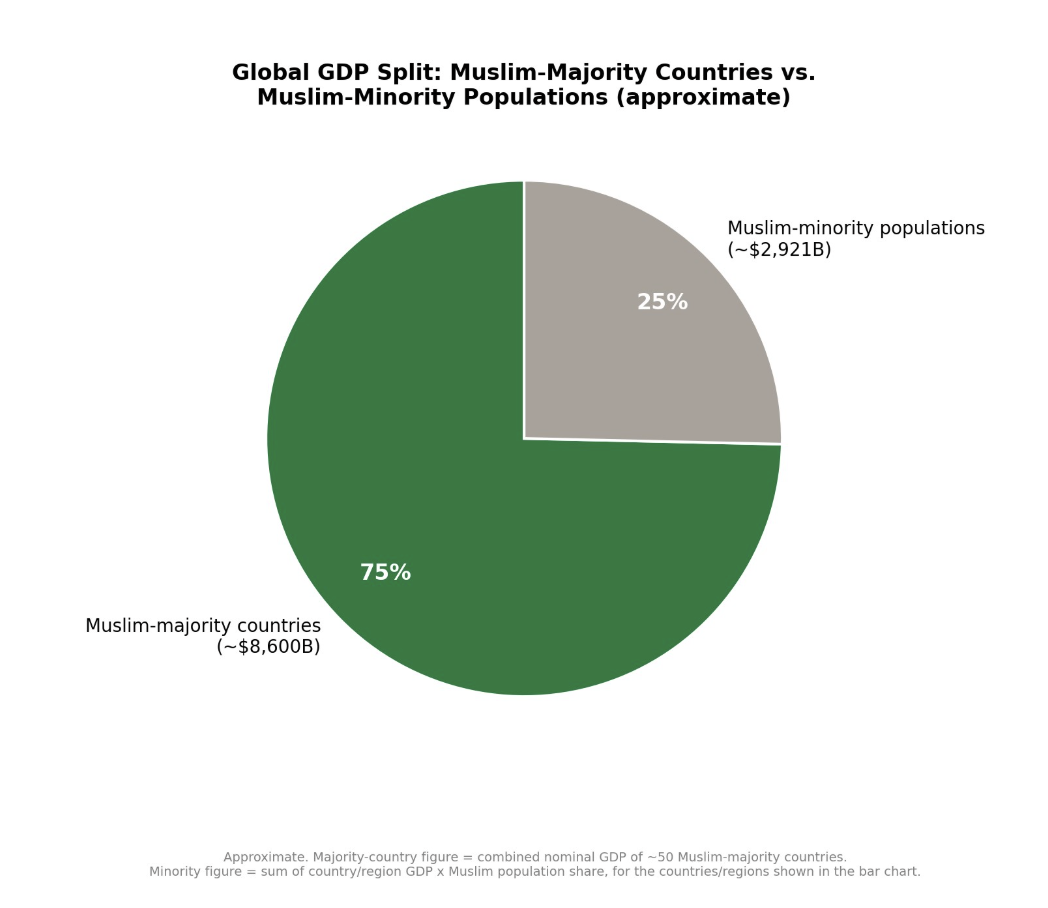
How does the combined GDP of the roughly 50 Muslim-majority countries and territories compare to the GDP attributable to Muslims living as minorities everywhere else? Summing approximate nominal GDP across all Muslim-majority countries (Indonesia, Pakistan, Turkey, Saudi Arabia, Nigeria, Egypt, Iran, Bangladesh, Malaysia, the Gulf states, and the rest of the ~50-country list) gives a combined figure of roughly $8.6 trillion. That compares with the roughly $2.9 trillion estimated above for Muslim-minority populations across the countries/regions covered in this report.
In other words, on this approximation, close to three-quarters of the economic activity associated with the world's Muslim population sits within Muslim-majority countries, and roughly a quarter is generated in countries where Muslims are a minority — a rough mirror of the 78%/22% population split described earlier in this report, though not identical to it, since GDP per capita varies substantially between Muslim-majority countries (from Gulf states with very high per-capita output to lower-income countries like Yemen, Somalia, and the Sahel states) and across minority contexts (from high-income Western Europe and North America to lower-income parts of sub-Saharan Africa and South Asia).
A note on sources and why the numbers vary
Muslim population figures differ meaningfully depending on the source, mainly because many of the countries with the largest Muslim populations — Saudi Arabia, most Gulf states, and China among them — do not ask about religion on their national census, forcing reliance on survey-based estimates. India's last religion census was in 2011, so its current Muslim count is a demographic projection rather than a fresh count. This article leans on Pew Research Center as the primary source because it is the only major tracker that combines over 2,700 censuses and surveys into a single, methodologically consistent, cross-country dataset — and it is the only one that models future growth. Country-level figures are cross-checked where possible against national censuses (where religion is asked) and the CIA World Factbook.
References
Hackett, C., Stonawski, M., Tong, Y., Kramer, S., & Shi, A. (2025). How the Global Religious Landscape Changed From 2010 to 2020. Pew Research Center. https://www.pewresearch.org/religion/2025/06/09/how-the-global-religious-landscape-changed-from-2010-to-2020/
Pew Research Center. (2017). Why Muslims are the world’s fastest-growing religious group. Pew Research Center, Washington, DC.
Pew Research Center. (2021). India’s Sex Ratio at Birth Begins to Normalize and related religious composition analyses of the 2011 Indian census with demographic projections. Pew Research Center, Washington, DC.
Pew Research Center. (2025). Countries with the most Muslims & global Muslim population change, 2010–2020. https://www.pewresearch.org/religion/2025/06/09/muslim-population-change/
Pew Research Center. (2011). The Future of the Global Muslim Population. https://www.pewresearch.org/religion/2011/01/27/the-future-of-the-global-muslim-population/
Pew Research Center. (2015). The Future of World Religions: Population Growth Projections, 2010–2050. https://www.pewresearch.org/religion/2015/04/02/religious-projections-2010-2050/
Pew Research Center. (2024). Religious Landscape Study, 2023–24. https://www.pewresearch.org/religion/religious-landscape-study/
United Nations, Department of Economic and Social Affairs, Population Division. (2024). World Population Prospects 2024. https://population.un.org/wpp/
CIA World Factbook. Country entries (religion, population). https://www.cia.gov/the-world-factbook/
World Population Review. National population and religion compilation, 2024–25. https://worldpopulationreview.com/
Central Intelligence Agency. The World Factbook — country entries for Indonesia, Pakistan, India, Nigeria, Bangladesh, and other listed countries. Central Intelligence Agency, Washington, DC.
PRRI. American Values Atlas — US religious composition survey data, used as a cross-check against the Pew 2023-24 Religious Landscape Study.
About the authors:
Esha Sarwar: Recent graduate of George Mason University with a Bachelor of Science in Business, with a concentration in Management Information Systems. Currently supporting MyLLife Inc. with administrative and social media responsibilities, as well as research for its economic and social justice programs.
Rashed Hasan: Founder & Director, MyLLife Inc., Alexandria, VA, and Professor of Practice, Management and Finance, George Mason University, Fairfax, VA
If you found this article informative & would like to support further research, click here to donate!
