






Most of us who are lifelong learners are familiar with the concept of Emotional Intelligence (EQ). Which refers to the capacity to recognise, understand, regulate, and use emotions effectively to guide thinking, behaviour, and relationships. Contemporary psychology, particularly through Daniel Goleman’s influential work, has highlighted EQ as a key determinant of leadership, well-being, and social effectiveness. Islam approaches emotional intelligence with a deeper moral and spiritual framework, anchoring emotional competencies with divine guidance, ethical responsibility, and the pursuit of ihsan (moral excellence).
EQ as perceived by a Muslim
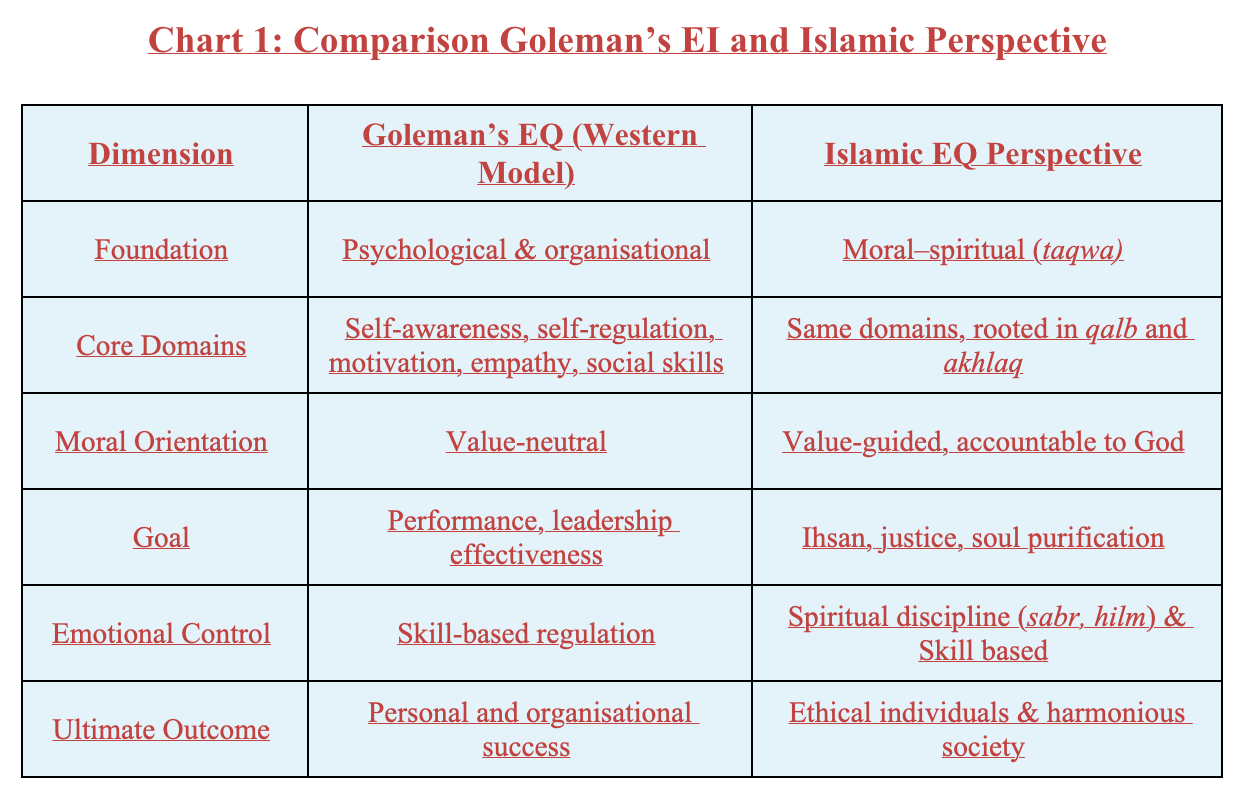
EQ is the ability to recognise, understand, regulate, and ethically express emotions in alignment with several key teachings of Islam - taqwa (God-consciousness), akhlaq (moral character), and adab (proper conduct). Emotions are not denied or suppressed; rather, they are acknowledged as part of the human condition (fitrah) —created by Allah to guide moral judgement and expressed behaviour. While Daniel Goleman’s mixed model (1995, 1998) defines EQ through five domains—self-awareness, self-regulation, motivation, empathy, and social skills—Islam integrates these competencies with the spiritual centre of the qalb (heart).
The Qur’an identifies the heart as the locus of emotional, moral, and spiritual insight.:
“It is not the eyes that are blind, but the hearts within the chests.” (Qur’an 22:46)
Thus, EQ is inseparable from spiritual intelligence and aims at tazkiyah al-nafs (purification of the soul) and hikmah (wisdom).
Purpose of EQ
The purpose of emotional intelligence in Islam is to cultivate inner balance and ethical relationships—both with Allah (ḥabl min Allah) and with humanity (ḥabl min al-nās). Unregulated emotions such as anger, envy, pride, or fear can lead to injustice, fractured families, and social discord. Regulated emotions, however, nurture sabr (patience), rahmah (compassion), hilm (gentleness), and ‘adl (justice).
The Qur’an elevates emotional restraint as a moral virtue: “Those who restrain anger and forgive people—Allah loves those who do good.” (Qur’an 3:134)
In any society, in particular multicultural societies such as the US, emotionally intelligent behaviour is essential for sustaining mutual respect, interfaith harmony, and peaceful coexistence.
Models and Beneficiaries of EQ
The supreme model of emotional intelligence in Islam is Prophet Muhammad ﷺ. His life exemplified emotional self-regulation, empathy, and moral courage. He responded to hostility with patience, corrected others with compassion, and showed deep emotional sensitivity to children, women, the poor, and even his enemies.
“The strong person is not the one who overpowers others, but the one who controls himself when angry.” (Ṣaḥīḥ al-Bukhārī)
Every Muslim is called to cultivate EQ: students developing resilience, educators teaching with empathy, parents nurturing emotional security, and leaders governing with justice and mercy.
Cultivating EQ in Islam
Islamic teachings and principles can provide a holistic framework for developing emotional intelligence. Muhasabah (self-reflection) strengthens self-awareness, while salah (prayer), sawm (fasting), and dhikr (remembrance of Allah) cultivate emotional regulation and discipline—paralleling Goleman’s domains of self-regulation and motivation.
Empathy and social awareness are nurtured through sadaqah (charity), service, and attentiveness to human dignity. The Prophet ﷺ said: “The merciful are shown mercy by the Most Merciful.” (Tirmidhī)
In Islam, ethical action ensures that emotional insight translates into just and compassionate behaviour.
Conclusion
While Western models such as Daniel Goleman’s emphasise emotional competencies for performance and leadership, Islam embeds emotional intelligence within a moral and spiritual vision of life. Emotional intelligence in Islam is not value-neutral; it is accountable to God and directed toward ethical excellence.
By integrating emotional awareness with faith, a Muslim and any person of faith can transform emotions into instruments of wisdom, and mercy, where humans flourish, benefiting individuals, communities, and multicultural societies alike.
Asma Abdullah, Ph.D., is an anthropologist, educator, and coach specializing in cultural dimensions and work-life integration. She conducts workshops and delivers talks on how culture influences social interaction and management. As a freelance trainer, she helps bridge cultural divides through a deeper understanding of how different groups think, feel, and act.
