





Carmen Reyes has lived just two blocks from Google’s Mesa, Arizona, data center for more than a decade. While the county urges residents to water their lawns no more than twice a week, Google’s facility has a permit to draw up to 4 million gallons of water per day as it expands, roughly the daily consumption of 23,000 Arizonans. At the same time, city officials continue to remind residents that Mesa is experiencing its driest conditions in more than a century (Moss, 2021).
Her story isn’t unusual, but it reflects what many communities across the country are experiencing. As AI infrastructure grows, the neighborhoods closest to these facilities bear the environmental burden, while the economic gains flow to shareholders, tech executives, and high‑income users. And most people using AI daily remain unaware of these hidden costs. That invisibility isn’t an accident. It’s built into the system.
The Invisibility Problem
Artificial intelligence is advancing rapidly across healthcare, finance, education, and climate science. But the infrastructure powering that progress carries a price tag that never appears on screen. When you draft an email with a large language model, you get no signal, no energy label, and no cost indicator, indicating what that interaction actually consumed. An LLM query uses roughly five times more electricity than a standard web search (IEA, 2023). Training a single frontier model generates carbon emissions comparable to several cars driven over their entire lifetimes, before a single user ever types a question (Hugging Face & Carnegie Mellon University, 2022).
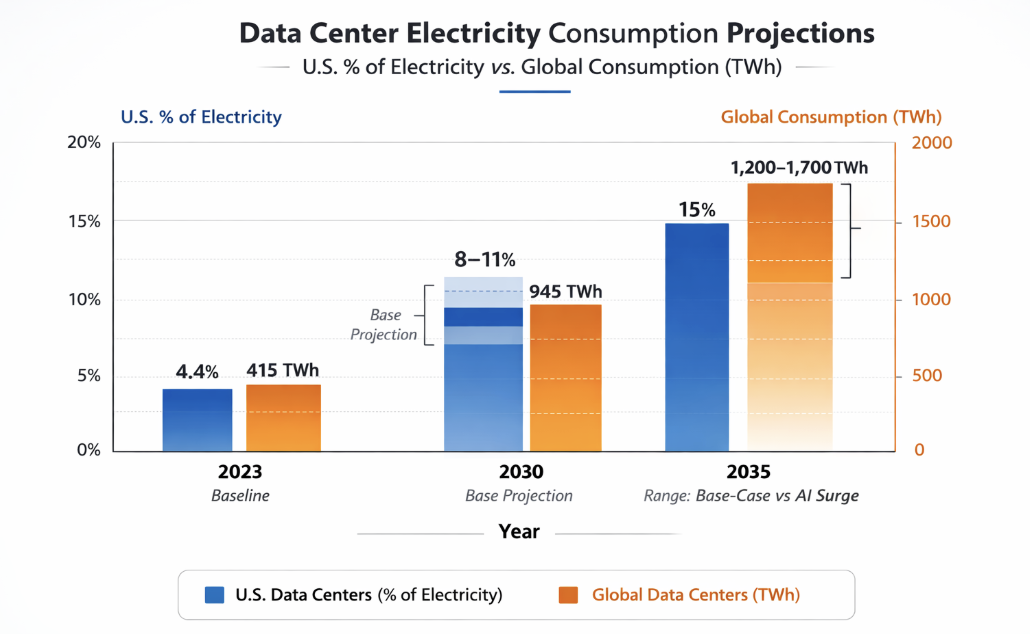
Data center electricity use is rising quickly. In the U.S., data centers used about 4.4% of all electricity in 2023, a share expected to increase to 8–11% by 2030 and potentially 15% by 2035 (DOE, 2023; Global Efficiency Intelligence, 2025). Globally, they consumed roughly 415 TWh in 2024, and the IEA projects this could more than double to 945 TWh by 2030 and reach 1,200–1,700 TWh by 2035, depending on AI expansion (IEA, 2025). AI is the main driver of this surge, with electricity demand from AI‑optimized data centers expected to more than quadruple by 2030 (IEA, 2025). In the U.S., data centers are projected to account for nearly half of all electricity demand growth over this period (IEA, 2025).
These aren't marginal numbers. They're the footprint of a major industrial system presenting itself to the public as effortless, clean, delivered from an invisible cloud.
We have seen before how transparency can reshape public understanding. Nutrition labels changed the way people think about food, and fuel‑economy ratings reshaped the car market. There is no technical reason we could not display real‑time energy use on every AI interface. The only real obstacle is that transparency would create accountability, and that is exactly what the industry prefers to avoid.
Energy and the Grid
In 2023, a single coal plant in West Virginia that had been scheduled for retirement was granted a two-year extension, specifically because a new data center complex in the region needed guaranteed power. The extension wasn't announced in a press release. It appeared in a utility commission filing. No AI company was named. That obscurity is the norm (Associated Press, 2025).
AI workloads operate at power levels seven to eight times higher than conventional data center applications (MIT News, 2025; PSU IEE, 2025). Their electricity demand spikes sharply and unpredictably, stressing local grids in ways standard computing does not. When grids face that pressure, utilities often respond in the worst possible ways for the climate: delaying coal plant retirements, running high-carbon natural gas peakers, and firing up diesel backup generators on-site.
Training gets most of the public attention, but inference, the ongoing, real-time operation of deployed models across search engines, office software, and healthcare platforms, is now the dominant and growing source of AI energy demand (IEA, 2024; MIT News, 2025). Every time a new AI feature reaches millions of users, that operational load increases again. Individual efficiency improvements in model architecture are consistently outpaced by the rapid expansion in overall use.
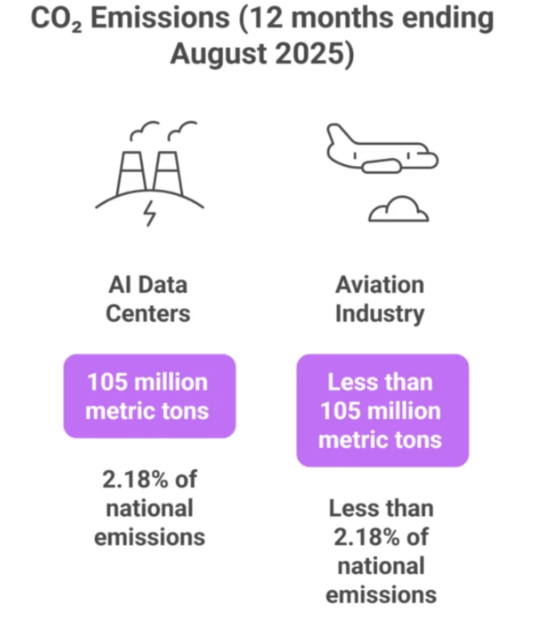
The emissions picture is stark. Data centers currently generate approximately 180 million metric tons of CO₂ per year globally. According to the International Energy Agency (IEA), this could rise to 300 million metric tons by 2035 under a base scenario, and up to 500 million metric tons in a high-growth scenario (IEA, 2025). In the United States, annual emissions from data center electricity use may peak between 63 and 83 million metric tons around 2030, depending on the pace of renewable energy deployment (Global Efficiency Intelligence, 2025). These figures highlight that data centers are among the fastest-growing sources of greenhouse gas emissions, underscoring the urgent need for mitigation strategies.
The climate justice issue is straightforward: the communities suffering the worst impacts of climate change, such as coastal towns facing sea-level rise and farming regions dealing with long-term droughts, contributed least to the emissions driving it, and benefit least from AI systems designed for wealthy, connected users. Microsoft, Google, and Amazon continue scaling infrastructure that accelerates those emissions while framing it as a sustainability journey.
Water: The Quiet Crisis
Carmen Reyes knows what a drought looks like from the inside. Her neighbors take their watering schedules seriously. They time their sprinklers to the twice-weekly limit. They watch the soil crack. Two blocks away, the building with no windows draws water at a scale the neighborhood cannot conceive of.
Cooling a data center requires roughly two liters of water per kilowatt-hour of electricity consumed (PSU IEE, 2025). Google's facilities used approximately 5.6 billion gallons of water in 2022, up nearly 20% the following year as AI demand climbed. Microsoft's water consumption rose 34% in the same period (Google, 2024; Microsoft, 2024).
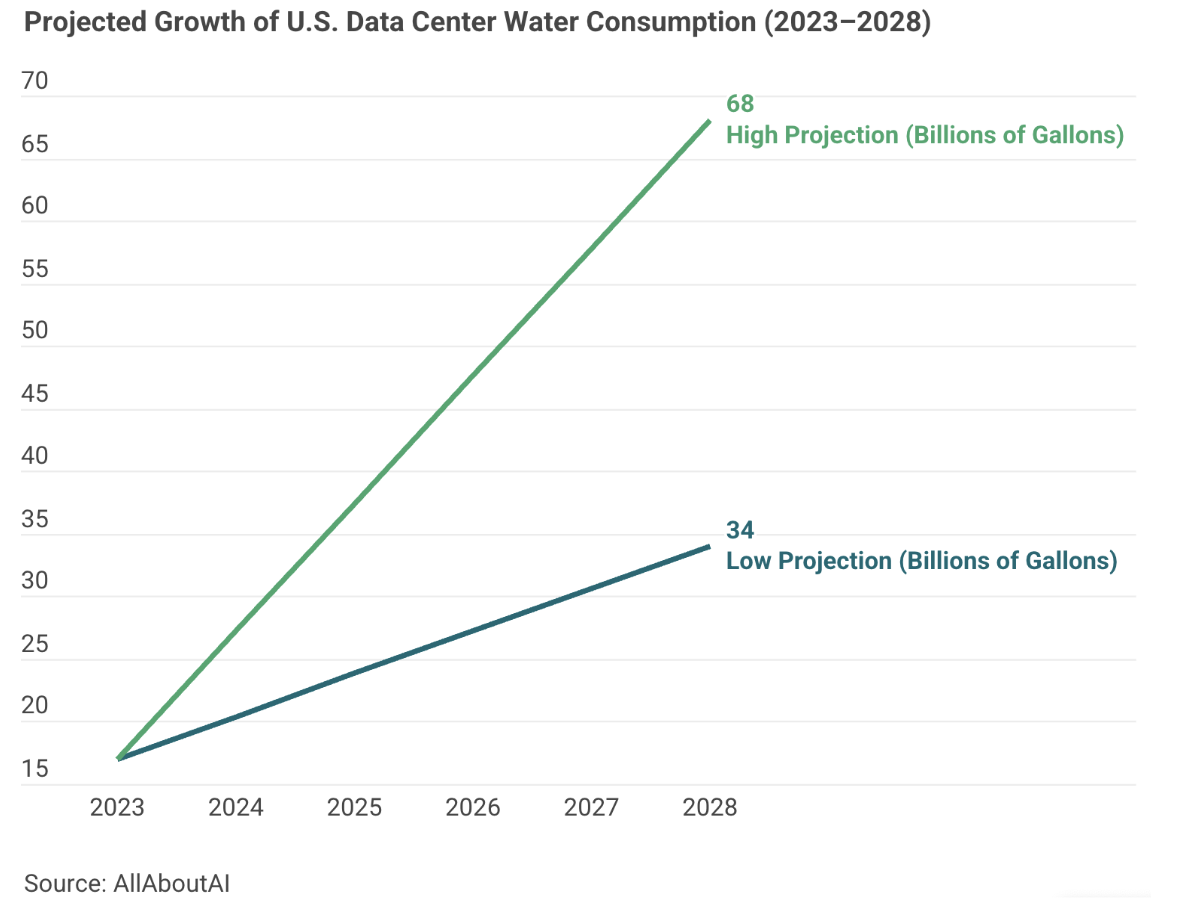
The trajectory over the next decade is alarming. Indirect water consumption tied to data center electricity generation in the U.S. is projected to nearly double from 54 billion gallons in 2025 to 91 billion gallons by 2030 (Bluefield Research, 2025). One analysis projects that U.S. data centers could require up to 1 trillion gallons of water annually by 2030 (Bluefield Research via Brookings, 2025). A peer-reviewed study published in 2025 found that without mitigation, global water consumption associated with data centers could increase more than sevenfold by mid-century (ScienceDirect, 2025). The carbon footprint of AI systems alone could generate water consumption equivalent to between 312.5 and 764.6 billion liters in 2025, roughly the amount New York City uses in five months (ScienceDirect, 2025).
These withdrawals come from real places under real stress. Amazon Web Services has developed a pattern of siting facilities in regions with cheap power and limited environmental oversight, which often means regions already facing water scarcity. Two-thirds of new data centers built or in development globally since 2022 are located in places already experiencing water stress (EthicalGEO, 2025).
There's also a pollution dimension that rarely gets discussed. Data centers using open-loop cooling draw water from rivers or municipal supplies, run it through heat exchangers, and discharge it warmer than it arrived. That thermal loading reduces dissolved oxygen in receiving waterways, disrupts fish spawning cycles, and accelerates algal blooms (UNEP, 2024; DOE, 2023). Most operators don't monitor the water bodies they're affecting, and most states don't require them to.
Closed-loop systems that recirculate water instead of continuously withdrawing it can cut consumption by 80–90%. The technology exists and works at scale. What's missing is any requirement to use it.
Carmen Reyes can't force Google to use it. She can't see the permit, can't attend the meeting where it was approved, and can't access data on daily withdrawals. The information that would let her understand what's happening two blocks from her home is not publicly available. That is not an oversight; it is a design choice.
The Supply Chain Nobody Discusses
GPU shipments to data centers jumped from 2.7 million units in 2022 to 3.9 million in 2023 — a 44% increase driven almost entirely by AI investment (NEA, 2025). Every one of those chips contains cobalt, lithium, copper, neodymium, and other materials pulled from some of the world's most environmentally and politically fragile places.
The Democratic Republic of Congo produces over 70% of the world's cobalt, much of it from artisanal mining in Katanga Province, where workers dig by hand, breathing cobalt dust tied to severe respiratory disease. Operations there have displaced Indigenous communities, contaminated water sources with acid drainage, and destroyed forests that those communities depended on (UNEP, 2024). In Chile's Atacama Desert, lithium extraction has reduced water flows in the Loa River system by an estimated 65% over three decades, threatening the Atacameño people's agriculture. In Inner Mongolia, rare earth processing has left toxic tailings lakes; nearby residents report elevated cancer rates and contaminated wells (UNEP, 2024; IEA, 2024).
Apple, Google, Microsoft, and Amazon publish supply chain reports identifying immediate suppliers. Almost none trace materials to their actual extraction sites. No U.S. federal law requires them to. The EU's Corporate Sustainability Due Diligence Directive, adopted in 2024, sets a more demanding standard, one that American tech companies have lobbied hard to keep from arriving here (UNEP, 2024; EESI, 2025).
E-Waste: The End of the Line
Only 22% of global electronic waste is formally recycled. Less than 1% of rare earth elements are recovered from discarded hardware (UNEP, 2024). The rest gets landfilled, incinerated, or shipped to informal processing sites where workers burn cables and circuit boards to recover metals, breathing smoke laced with lead, mercury, cadmium, and brominated flame retardants.
AI hardware makes this worse because it turns over so fast. A GPU that required significant energy and rare materials to manufacture may be commercially obsolete in 18–24 months, not because it failed, but because a faster model exists. This churn accelerates the waste stream in ways the industry doesn't track or disclose (NEA, 2025).
Extended producer responsibility laws, requiring manufacturers to fund end-of-life hardware recovery, are standard in the EU and don't exist federally in the U.S. Tech companies have pushed back on them. The communities handling the resulting waste carry health costs that never appear in any corporate sustainability report.
What the Sustainability Reports Don't Say
Microsoft pledged carbon negativity by 2030 and 100% renewable energy sourcing by 2025. Between 2020 and 2023, its emissions rose 29%, driven directly by AI expansion (Microsoft, 2024; EESI, 2025). The company has not publicly explained how those two facts coexist, nor whether the 2030 target remains achievable.
Google has claimed carbon neutrality through offsets since 2007, while its absolute electricity consumption keeps rising with AI demand. The offsets backing that claim, primarily forest carbon credits, have come under serious scrutiny. Researchers have documented systematic over-crediting in the forest carbon market, meaning many purchases don't represent the actual emissions reductions companies claim (Google, 2024; IEA, 2024).
Amazon Web Services declines to disclose total emissions data, citing competitive sensitivity (Amazon Sustainability Report, 2024). That makes independent verification of its sustainability claims impossible. AWS does emphasize efficiency improvements in custom chips like Graviton and Trainium, but efficiency per watt means nothing if total compute demand is growing faster than the efficiency gains. The math still points upward.
Why Policy Has Failed
Amazon, Google, Microsoft, and Meta collectively spent over $70 million on federal lobbying in 2023, with significant AI policy focus (EESI, 2025). The result is predictable: the Artificial Intelligence Environmental Impacts Act, the main federal attempt at oversight, centered on voluntary reporting and never made it out of committee (CRS, 2024). The Department of Energy's AI Act focuses on grid reliability and research, with no binding environmental standards (DOE, 2024).
States are competing to attract data centers with tax breaks and relaxed oversight, a race to the bottom that makes any state attempting stricter standards less competitive. Virginia, home to more data centers than anywhere else in the country, has repeatedly declined to impose water use or emissions reporting requirements on the industry (NEA, 2025; EESI, 2025). In 2025, the most consequential transparency bill, which would have required reporting on energy use, water consumption, and emissions, was weakened and ultimately killed before reaching the governor's desk. A bill authorizing local governments to evaluate data center noise, water, and land-use impacts was vetoed by Republican Governor Glenn Youngkin (E&E News, 2025).
In New Jersey and California, data center water-use reporting bills passed both legislative chambers but were vetoed by Democratic governors. (E&E News, 2025). If your assumption was that this is a Republican-only problem, the record doesn't support it. The governors of two of the most progressive states in the country looked at bills requiring data centers to report how much water they use and said no. The reason is the same regardless of party: data centers bring investment, jobs, and tax revenue. Transparency creates friction. Friction costs deals.
Other countries have moved differently. The EU AI Act requires transparency on resource use. China has imposed binding efficiency standards on data centers that have produced measurable results. The U.S. has no federal equivalent to any of these.
What Would Actually Help
Mandatory disclosure: Data centers above a threshold size should report real-time energy consumption, water use, and hardware lifecycle data under standardized methodologies, not metrics that companies choose themselves. The EPA's Greenhouse Gas Reporting Program is the existing model to extend.
Real renewable energy: Federal cloud contracts should require verified renewable electricity procurement, not Renewable Energy Credits. Procurement standards have driven measurable improvements in the automotive, appliance, and building sectors.
Community rights: Genuine environmental impact assessments before data center permits are issued, with real community participation. Mandatory benefit agreements covering local hiring, health monitoring, noise, and air quality. These protections shouldn't require communities to fight for them individually.
Producer responsibility. Manufacturers should fund and manage end-of-life hardware recovery. This is already law in the EU. It should be the law here.
Pressure Points: Where Action Is Possible Now
Microsoft is the most exposed company on this issue. Its 29% emissions increase against a carbon-negativity pledge is a concrete, documentable contradiction that institutional investors can and should challenge (Microsoft, 2024). The As You Sow coalition has filed shareholder resolutions on AI emissions disclosure and is worth tracking.
On legislation, Senator Ed Markey (D-MA) is the primary champion of the Artificial Intelligence Environmental Impacts Act, and Republican senators in water-stressed data center states like Nevada, Arizona, and Texas are the most likely pressure points for bipartisan support (CRS, 2024). The Sierra Club and Environmental Defense Fund are both actively lobbying on data center grid impacts at the state level.
For communities near data centers, public records requests for water withdrawal permits are an accessible starting point. In Virginia specifically, the Loudoun Climate Project and the Piedmont Environmental Council have built organizing infrastructure around data center accountability and offer model public comment templates.
Making It Visible
Carmen Reyes waters her tree on the schedule the county sets. An unmarked building two blocks away draws a million gallons a day under no equivalent constraint. That gap, between what AI's infrastructure consumes and what the people living around it know or can do about it, is not a communication failure. It's the outcome of deliberate choices about what to disclose, where to build, and who gets to decide.
The tools to change this exist. Energy labels. Water permit disclosures. Demographic mapping of data center siting. Binding supply chain transparency. Verified renewable procurement. These are adaptations of regulatory frameworks that have worked in other industries, applied to one that has so far avoided them.
Once AI's costs are visible, on screen, in permits, in corporate filings, the argument that they're acceptable, or unavoidable, or somebody else's problem becomes much harder to sustain. That's exactly why making them visible has been so effectively resisted. And exactly why it matters.
References
Amazon Web Services. (2024). Amazon sustainability report. https://sustainability.aboutamazon.com/2024-report
Associated Press. (2025, April 2). Coal-fired power plant, now retired, to become massive gas-powered campus for AI, data centers. Courthouse News Service. https://www.courthousenews.com/coal-fired-power-plant-now-retired-to-become-massive-gas-powered-campus-for-ai-data-centers/
Bay Journal. (2025, October). As data centers multiply in the Chesapeake region, water use increases too. https://www.bayjournal.com/news/pollution/as-data-centers-multiply-in-the-chesapeake-region-water-use-increases-too/article_ebcb4891-d6d6-4b42-8bb5-14bf61981531.html
Bluefield Research. (2025). The Water-Power Nexus: How Data Centers Are Reshaping the U.S. Water Landscape. https://smartwatermagazine.com/news/bluefield-research/ais-electricity-boom-redrawing-us-water-map
Climate Change News. (2025). UN adopts first-ever resolution on AI environmental impacts. https://www.climatechangenews.com/2025/12/12/un-adopts-first-ever-resolution-artificial-intelligence-ai-environment-lifecycle-unea/
Congressional Research Service. (2024). S.3732 – Artificial Intelligence Environmental Impacts Act of 2024. https://www.congress.gov/bill/118th-congress/senate-bill/3732
Data Center Dynamics. (2021). Huge data center moves forward in Mesa despite Arizona water concerns. https://www.datacenterdynamics.com/en/news/huge-data-center-moves-forward-in-mesa-despite-arizona-water-concerns/
E&E News. (2025, October). States push to end secrecy over data center water use. https://www.eenews.net/articles/states-push-to-end-secrecy-over-data-center-water-use/
Environmental and Energy Study Institute. (2025, September). Artificial intelligence: Implications for energy and the environment. https://www.advanceesg.org/ai-is-changing-energy-production/?
Global Efficiency Intelligence. (2025). Data Centers in the AI Era: Energy and Emissions Impacts in the U.S. and Key States. https://www.globalefficiencyintel.com/data-centers-in-the-ai-era-energy-and-emissions-impacts-in-the-us-and-key-states
Google. (2024). 2024 environmental report. https://sustainability.google/reports/google-2024-environmental-report/
Hugging Face & Carnegie Mellon University. (2022). Estimating the carbon footprint of BLOOM, a 176B parameter language model. arXiv. https://arxiv.org/abs/2211.02001
International Energy Agency. (2023). Electricity 2024: Analysis and forecast to 2026. https://www.iea.org/reports/electricity-2024
International Energy Agency. (2024). Data centres and data transmission networks. https://www.iea.org/energy-system/buildings/data-centres-and-data-transmission-networks
Loudoun Climate Project. (2025). The dark side of data centers. https://loudounclimate.org/data-centers/
Loudoun County Government. (2024). A holistic review of data center impacts in Loudoun County, VA. https://www.loudoun.gov/ArchiveCenter/ViewFile/Item/13979
Microsoft Corporation. (2024). 2024 environmental sustainability report. https://www.microsoft.com/en-us/corporate-responsibility/sustainability/report
MIT News. (2025, January). Explained: Generative AI's environmental impact. https://news.mit.edu/2025/explained-generative-ai-environmental-impact-0117
National Education Association. (2025, June). Environmental impact of artificial intelligence. https://www.nea.org/professional-excellence/student-engagement/tools-tips/environmental-impact-ai
Penn State Institute of Energy and the Environment. (2025, April). Why AI uses so much energy — and what we can do about it. https://iee.psu.edu/news/blog/why-ai-uses-so-much-energy-and-what-we-can-do-about-it
Piedmont Environmental Council. (2024). Responsible data center development. https://vcnva.org/agenda-item/responsible-data-center-development/
Sierra Club Virginia. (2025). Data center impacts in Virginia. https://www.sierraclub.org/virginia/roanoke/data-center-impacts-virginia
Source Material / The Guardian. (2025, June). Big Tech's data centres will take water from the world's driest areas. https://www.source-material.org/amazon-microsoft-google-trump-data-centres-water-use/
United Nations Environment Programme. (2024). Environmental impacts of artificial intelligence: A preliminary assessment. https://www.unep.org/news-and-stories/story/ai-has-environmental-problem-heres-what-world-can-do-about
U.S. Department of Energy. (2023). United States data center energy usage report. https://www.energy.gov/articles/doe-releases-new-report-evaluating-increase-electricity-demand-data-centers
U.S. Department of Energy. (2024). Department of Energy Artificial Intelligence Act. https://www.congress.gov/bill/118th-congress/house-bill/9671
