






Picture a family that has paid its homeowners premium on time for years. A storm tears shingles off the roof and water reaches the ceiling. They file a claim. Weeks later, a letter arrives: the claim is closed, with no payment. Maybe the damage fell below the deductible. Maybe an exclusion applied. Maybe the claim was handled unfairly. The letter does not say which, and the family pays for the repair alone.
This is a hypothetical, but it is the situation behind a rare bipartisan Senate unity and inquiry. Senators Elizabeth Warren (D-Mass.) and Josh Hawley (R-Mo.) have asked six big insurers why a growing share of home and auto claims end with no payment, and whether policyholders are being treated fairly. Here is what the evidence shows, from the policyholder's side of the table.
What this means for you
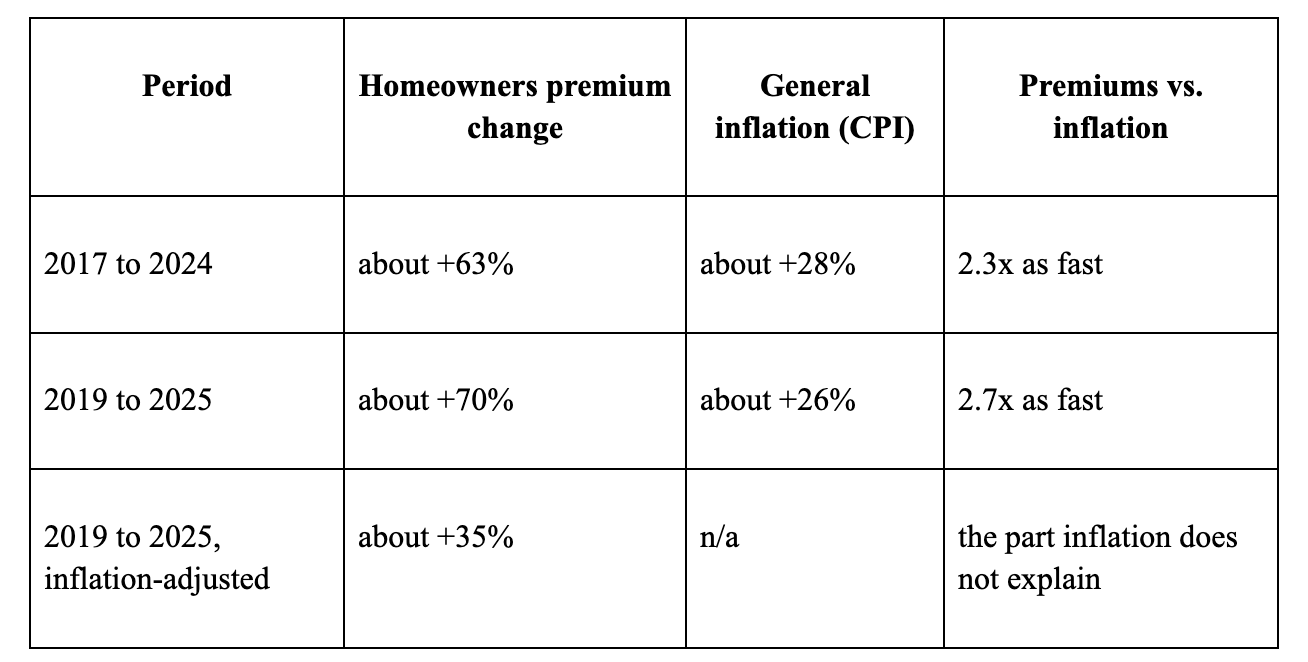
- You are paying more. Homeowners premiums rose roughly 63% to 70% over about the last decade, depending on the study.
- You may be getting less. A rising share of claims close with no payment. Most are below the deductible or otherwise not covered, but you often cannot tell which.
- You cannot easily check either one. Pricing and claim decisions rest on data only the insurer sees.
- You do have rights. Your insurer owes you good faith, a written reason for a denial, and a way to appeal, including to your state insurance department.
Your premium: rising faster than inflation
Federal Reserve Bank of Dallas researchers found homeowners' premiums rose about 70% between 2019 and 2025. Insurance now makes up about 14% of the average homeowner's monthly payment, up from 10% in 2013. Another study put the rise at about 63% from 2017 to 2024.
Over the same periods, prices in general rose far less. Inflation explains only about a third of the increase.
The gap was widest in 2024, when approved rate increases ran about 10 points above inflation. It narrowed in 2025 and nearly disappeared in early 2026, partly because rate increases slowed and partly because inflation picked back up. The worst of the price shock may be over, but the earlier jumps are still in everyone’s bills.
The year-by-year picture shows when the gap opened and how it has narrowed.
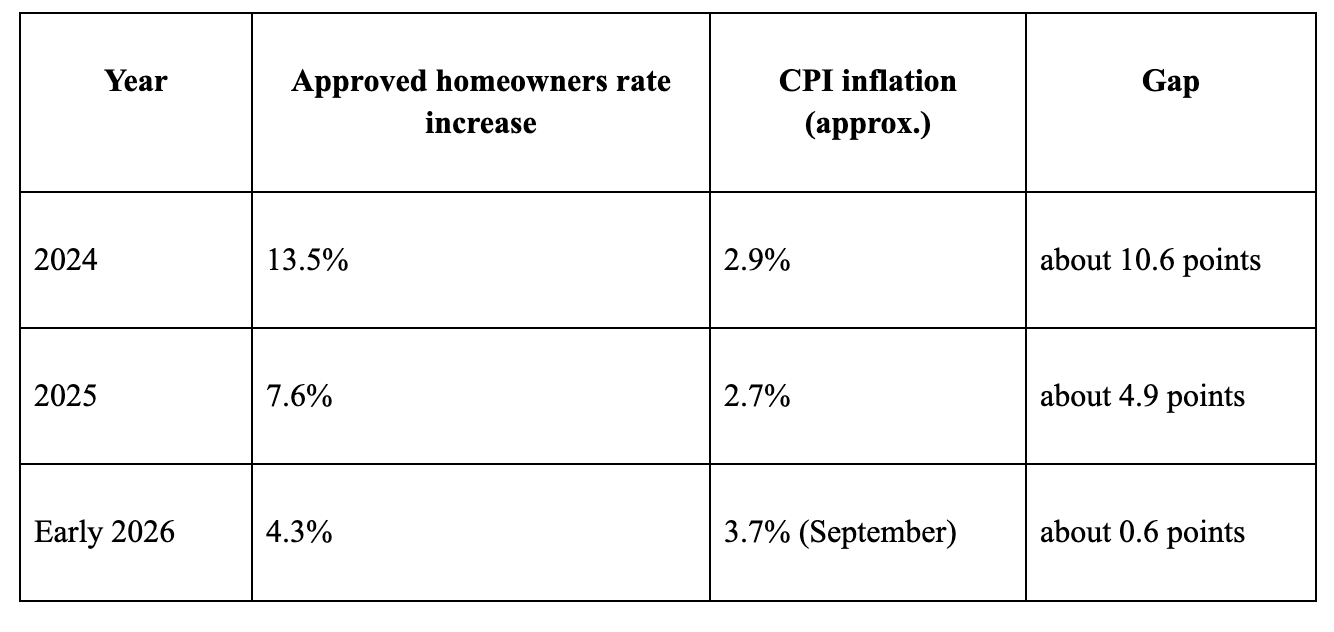
The gap was widest in 2024, when approved rate increases ran about 10 points above inflation. It narrowed in 2025 and nearly disappeared in early 2026, partly because rate increases slowed and partly because inflation picked back up. The worst of the price shock may be over, but the earlier jumps are still in everyone’s bills.
Why the increases were not all inflation
General inflation is the wrong yardstick for insurers, and much of the increase has real causes:
- Rebuilding costs have risen 2% to 9% a year since 2015, so every claim costs more.
- Reinsurance, the insurance insurers buy for themselves, rose sharply: by one trade analysis, 107% over five years, against a 62% rise in premiums.
- U.S. insured disaster losses reached about $103 billion in 2025, roughly 12% above the ten-year average.
- Homeowners lines lost money on underwriting in 2023 and 2024, and cumulative losses topped $35 billion over the five years before 2025.
Is the increase justified?
Partly. Insurers had a genuine problem to fix, and their costs have outrun the CPI. The gap between premiums and inflation is also closing, as the second table shows, and inflation has climbed again. The September 2026 reading was 3.7%, up from 3.4% in August, driven mainly by energy.
But there are reasons to ask harder questions:
- Rates are set on past losses, so they can overshoot once costs ease. Auto shows this: after a swing to profit, State Farm cut auto rates in 40 states and declared a $5 billion dividend, and Allstate announced average cuts of 17% for 7.8 million customers.
- The models behind rate filings are proprietary, and researchers found California filings cluster just under the 7% increase that triggers a public hearing.
- Some jumps were large, such as State Farm's 27% average homeowners increase in Illinois last summer.
- Industry surplus, the financial cushion, sits at a record $1.3 trillion.
The fair conclusion: the increases were partly justified, but regulators and consumers lack the data to confirm they were set fairly.
In conclusion, Inflation explains only about a third of the price increase, while the rest comes from insurance-specific costs like rebuilding, reinsurance and disasters. Those costs are real, but the public cannot verify how much of the increase they justify. That gap in transparency is why consumers are upset and why the senators are asking for data.
When you file a claim, how often do you get nothing?
The Wall Street Journal, analyzing insurers' regulatory filings, found the five largest home insurers paid nothing on more than 44% of claims resolved in 2025, up from 36%. For auto liability and medical claims the figure was 45%, up from about 35%.
An unpaid claim is not automatically a wrongful denial. Insurers and trade groups point out that "closed without payment" includes losses below the deductible, withdrawn and duplicate claims, and uncovered damage such as flood. They add that the WSJ left out claims still open, and that insurers paid 7.35 million homeowners claims in 2024. USAA says that after adjusting for those categories, fewer than 6% of its claims were denied.
Independent data support part of that and complicate the rest:
- Deductibles are the biggest single reason. After Hurricane Milton, Florida insurers closed more than 95,000 claims without payment. About 39,200 were below the deductible, about 32,000 were closed for administrative reasons, and only 18 were fraud.
- Deductibles keep rising. Insurers raised standard deductibles, added separate wind and hail deductibles, and in some cases moved to a percentage of the home's value. Customers also pick higher deductibles to hold premiums down.
- Insurers admit they got tougher. The WSJ cites analysts and executives saying insurers responded to post-pandemic losses partly by tightening claims handling.
- It varies a lot by company and state. Weiss Ratings found 47% of Texas homeowners claims closed unpaid, with ten insurers above 50%. Erie, outside the top five, paid more claims than a decade earlier. Spread like that suggests company practices matter, not just weather.
- A zero-payment claim can still cost you. In some states it can raise your rate or lead to nonrenewal. Texas bars that.
Why you can pay more and get less
The pieces fit together in an uncomfortable way. After costly years, insurers raised prices and tightened what they pay at the same time. Many customers then raised their deductibles to cut the bill, which means more ordinary losses fall below the line and close unpaid. Each step looks reasonable on its own. Together, the household pays more and carries more of every loss.
The hardest risk to see is claims handling. Delay, low estimates, repeated adjuster changes and thin explanations never show up in a paid-or-unpaid percentage. Until insurers report why claims close, and how many decisions are reversed on appeal, no one outside the companies can say how much of the rise comes from deductibles, exclusions, disputed valuations or tougher handling. A rising unpaid-claim rate is a strong reason to demand better data. It is not proof of wrongdoing.
Where the profit rebound came from
Industry profits did rebound. AM Best reports U.S. property/casualty underwriting income nearly tripled in the first half of 2026. But the split between price and weather is clear in its own numbers:
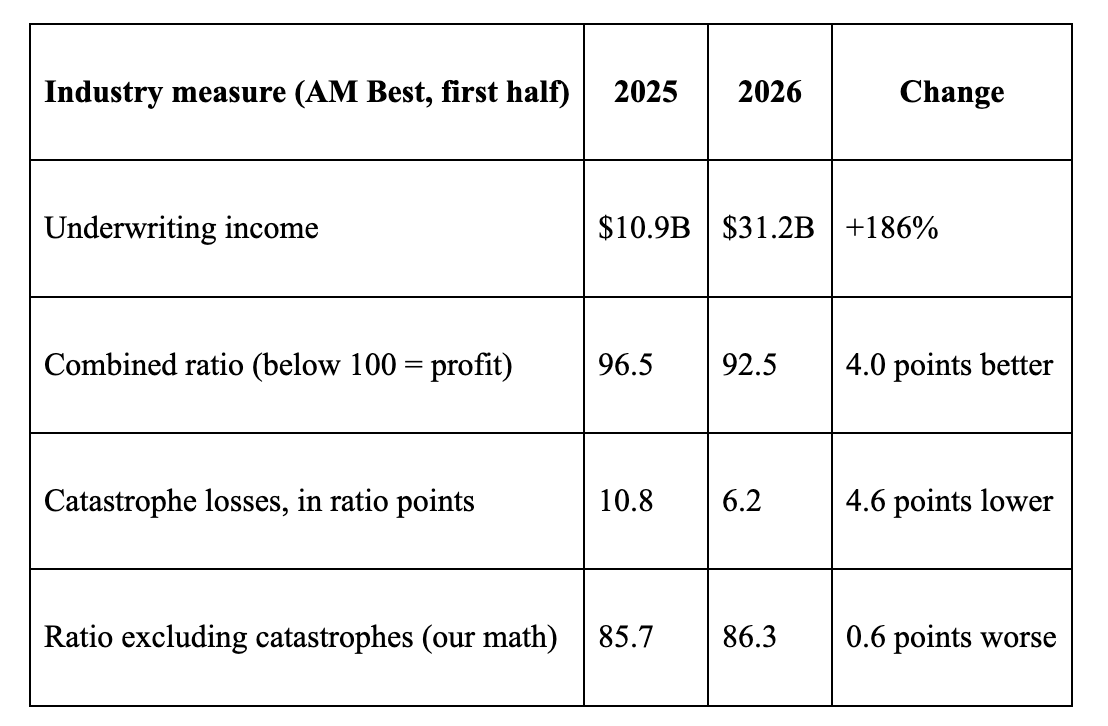
The drop in catastrophe losses, which came as the January 2025 California wildfires left the comparison, is larger than the entire improvement. Excluding catastrophes, results slipped slightly. By rough math (each ratio point is worth about $5 billion over six months), weather was worth about $23 billion, offset by about $3 billion of other deterioration, for a net gain of about $20 billion. Premiums grew only 3%.
So over the past year, price did not drive the jump. Over the past several years it did build the base: homeowners insurers went from losses in 2023 and 2024 to a $16.5 billion underwriting profit in 2025, while approved rate increases ran 13.5% in 2024, 7.6% in 2025 and 4.3% in early 2026. Softer reinsurance, reserve releases and Florida's litigation reforms helped too. No public data separates profit by cause precisely, and nothing shows that claim denials contributed. That is why the senators ask insurers to quantify each factor themselves.
What insurers owe you
The legal term is not "duty of care" but the duty of good faith and fair dealing. In insurance it means the company must handle its own policyholder's claim honestly and promptly and cannot put its interests ahead of the insured's. Every state also has an unfair claims practices law, typically requiring prompt investigation, a decision within a reasonable time, fair settlement once liability is clear, and a written reason for any denial.
The protection has limits. It generally does not apply where there is no coverage, so a properly excluded or below-deductible claim is not a violation. In some states, such as Colorado, the statute itself gives you no right to sue. Delay and lowball estimates are hard for one family to prove, and bad-faith suits are slow and costly. Insurers can also point to written procedures as evidence of good faith, which is why regulators' real-world file reviews matter.
What the senators want, and what should change
The senators' letters do not allege specific violations. They ask for the data a policyholder cannot get alone. The State Farm letter, due Oct. 16, requests: ten years of paid and unpaid claims by peril and by reason; how many decisions were appealed and reversed; the main factors behind the rise, quantified; changes to claims policies since 2015; any adjuster pay or bonus tied to payment or denial metrics; use of AI and its safeguards; and a commitment to publish annual claims data. No public insurer replies had been found as of this writing. The letters also went to Allstate, USAA, Farmers, Liberty Mutual and American Family, which together write about half of U.S. homeowners premium.
Because policyholders cannot see how premiums are built or why claims close, the fix that fits is transparency plus a workable way to correct mistakes. Options drawn from the senators, regulators and consumer advocates include:
- Public claims reporting with standard reasons for nonpayment, timing, disputes and later payments.
- Plain-language rate explanations showing how much of an increase reflects claims, reinsurance, expenses and profit, with a prompt revisit if losses improve.
- Dollars and delays, not just counts, including partial payments and underpayments.
- Usable explanations: the policy language, the facts, the deductible or depreciation math, and how to dispute.
- Deadlines and a named contact when a claim changes hands.
- Human review before an AI-supported denial becomes final.
- No penalty for zero-payment claims, as Texas does, defined carefully for surcharges, nonrenewal and claims history.
Industry groups warn that new reporting could mislabel properly closed claims, raise costs that flow back into premiums, and discourage coverage in disaster-prone states. Disclosure built on standard definitions, separating below-deductible and withdrawn claims from formal denials, is the version most likely to meet both concerns.
What you can do now
- Read your deductibles. Look for separate wind, hail or percentage deductibles, and whether the policy pays replacement cost or depreciated value. Standard policies generally exclude floods.
- Weigh the deductible trade. Compare the premium savings against what you would owe on a likely loss, and compare quotes, since rates in one ZIP code can vary widely.
- Keep records. Save photos, receipts, estimates and a dated log of calls, and take reasonable steps to prevent further damage.
- Ask for the reason in writing, with the policy provision, the facts and the payment calculation.
- Challenge promptly. Ask about the insurer's dispute process and contact your state insurance department. Remedies and deadlines vary by state.
Insurance is, at its core, an agreement to share risk. Many in our community will recognize the same idea in the cooperative guarantee behind takaful. The test of any insurance system is whether that sharing holds at the moment of need. A policy cannot cover every loss, but it should deliver what it promises, with decisions that are timely, understandable and open to correction.
State Farm: stronger finances and fair treatment are separate questions
For Families recovering from disaster, fair treatment means more than eventually receiving a check.
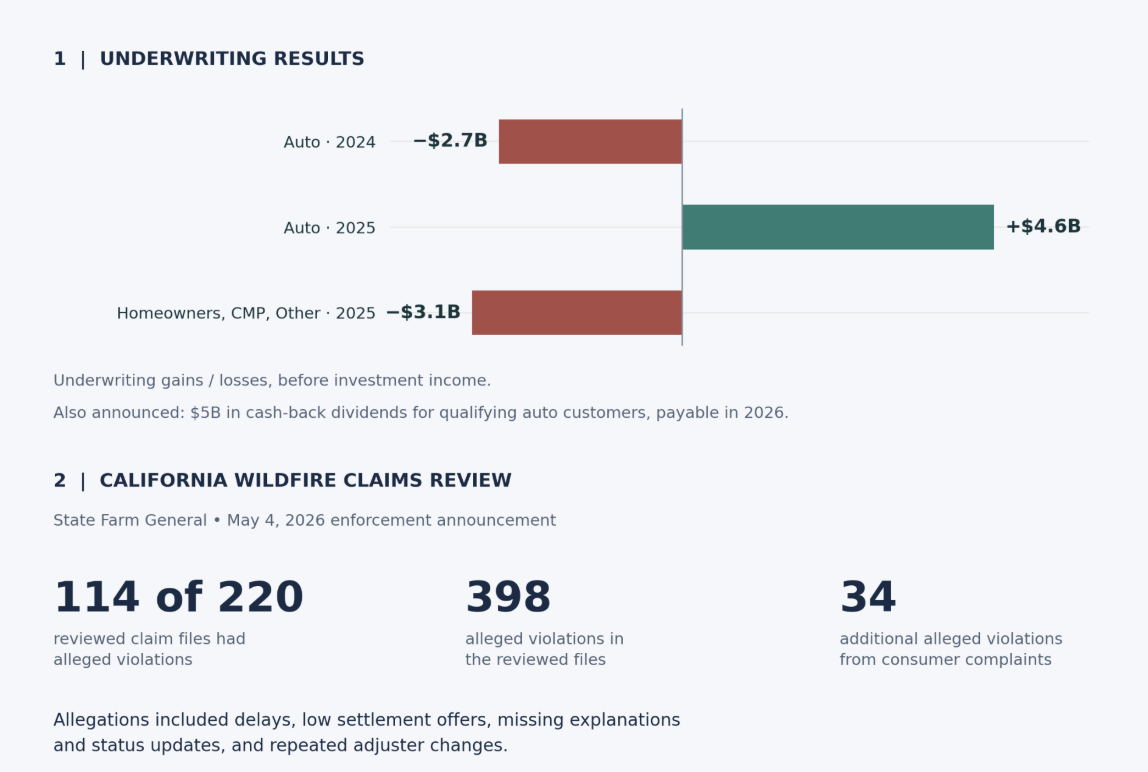
Copilot AI was used to create Image based on Findings from California Home/Auto Insurance Case Study
As the graphic shows, State Farms’s auto underwriting results improved sharply in 2025, while its homeowners-related business line continued to report a loss. But, financial performance and fairness in claims handling are separate questions.
California’s May 2026 action against State Farm General focuses on the latter. Regulators alleged delays, unreasonably low settlement offers, missing explanations and status updates, and repeated adjuster changes in Los Angeles wildfire claims. The graphic’s violation counts are not counts of denied claims or a nationwide denial rate.
State Farm disputed allegations of a general practice of mishandling or intentionally underpaying wildfire claims.
California’s findings go beyond complaints about slow service. The Department of Insurance says its intervention led State Farm General to reopen claims and make additional payments to several policyholders. In one case, regulators said internal company communications acknowledged that a customer should have been compensated sooner. Those findings provide concrete grounds to scrutinize claims handling, even though they do not establish that underpayment drove State Farm’s financial turnaround. The examination report was finalized, but its alleged violations had not undergone a formal administrative or judicial process yet.
The standard for oversight should therefore go beyond whether any payment arrives: Did the insurer act promptly, explain its decision, and meet its policy obligation?
What those disputes mean for families
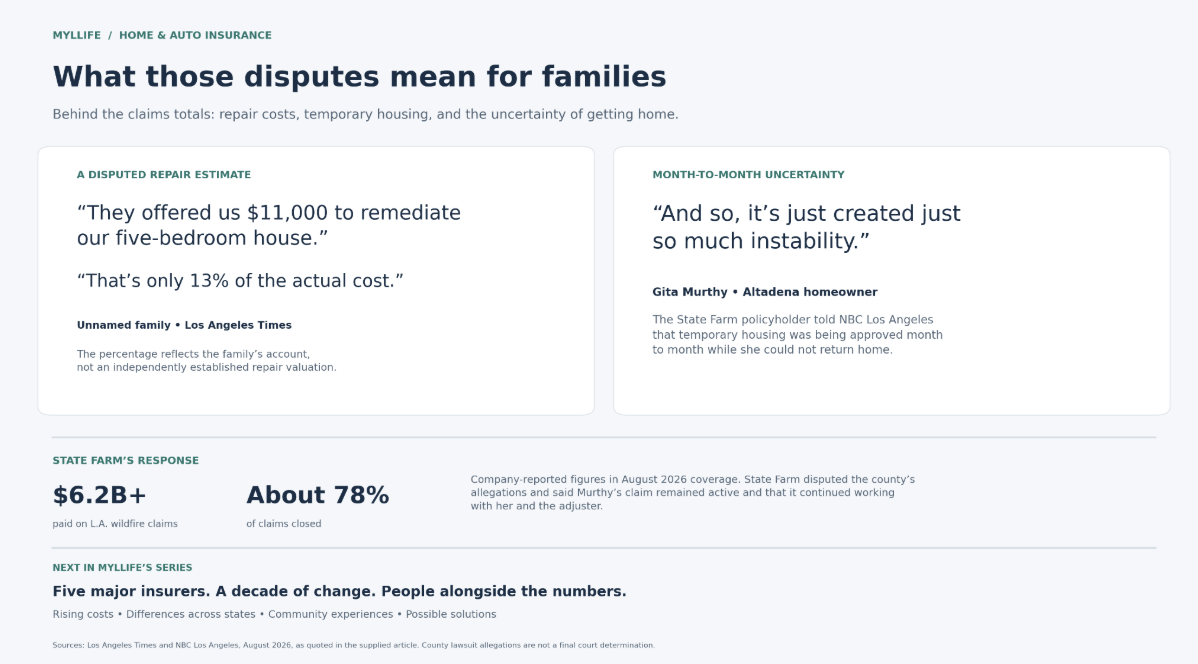
Copilot AI was used to create Image based on Findings from California Insurance Community Anecdotes
Los Angeles County’s August 2026 lawsuit alleged that State Farm delayed, denied, or underpaid wildfire claims. State Farm disputed those allegations, which were not a final court determination.
The accounts in the graphic show what these disputes can mean at home: a family questioning whether a repair offer would cover its costs, and Altadena homeowner Gita Murthy describing the instability of month-to-month temporary housing. State Farm said Murthy’s claim remained active and that it continued working with her and the adjuster.
Company payment totals matter, but so does each family’s path to recovery. As Murthy told NBC Los Angeles: “The thing that would make recovery possible would be being back in our home and having some semblance of normalcy in our life. And that hasn’t happened.”
For families like these, insurance is about having somewhere safe to live, getting back on the road, and recovering without falling deeper into financial strain. Insurance should help families rebuild and regain stability. Myllife’s home and auto insurance series will put people alongside the numbers, examining five major insurers, a decade of change, and community experiences across states. We will explore why costs are rising, how claims are handled, and what solutions, from state protections to approaches abroad could help. Our goal is not to assume wrongdoing, but to make insurance easier to understand and ask whether it delivers the protection families count on.
Sources
- AM Best 2026 results via Insurance Business, Reinsurance News and Beinsure
- Resources for the Future: The Evolving US Homeowners Insurance Market
- Insurance Business: Why has home insurance gone up so much? and MoneyGeek
- Wall Street Journal: The Home-Insurance Coin Flip
- Insurance Journal: Industry reacts to senators' letter and CLM: Triple-I on closed claims
- Hurricane Milton closed-claim data (policyholder-side law firm summarizing Florida regulator data) and Weiss Ratings on Texas
- State Farm 2025 results and Repairer Driven News on State Farm and Allstate
- Senate Banking Committee letter to State Farm
- Good-faith law: CLM, Texas Department of Insurance, Colorado Bar Association treatise
- From the original draft: Ge et al. (Federal Reserve Bank of Dallas); NAIC 2025 industry report; California Department of Insurance, May 4, 2026
- https://www.insurance.ca.gov/0400-news/0100-press-releases/2026/release019-2026.cfm
- https://legaldocs.insurance.ca.gov/CyberDOCS/quickstart.asp?library=docs_web&show=VIEW:371905:HTML&papi=bypassautopapiact&noframes=yes
- https://mynewsla.com/business/2026/05/04/alleged-mishandling-of-la-wildfire-claims-by-state-farm-sparks-legal-action-3/
- LA County files lawsuit against State Farm over wildfires – NBC Los Angeles
- L.A. County sues State Farm over its handling of wildfire claims - Los Angeles Times
- Official Data Foundation, CPI 2019 to 2025; SimianX, US CPI report, September 2026
If you found this article informative & would like to support further research, click here to donate to our Year-End Fundraiser!
