





Why the Conversation?
Some form of wealth tax has been in the political and civil discourse in the US for the last decade, partly due to the realization that economic and social inequity has grown too far and without intervention it might be difficult to reverse. The so-called free market will not reverse the trend, especially the way the Wall Street pushes the free market to operate – a mantra for profit maximation at all cost, even at moral peril and social upheaval.
Senator Elizabeth Warren introduced the idea of a wealth tax on the super-rich while many of the billionaire are now aspiring trillionaires with Elon Musk leading the pack. How does a society like USA, the richest nation on earth and most powerful military force in the world simultaneously deal with wealth abundance on one hand and widespread poverty on the other? As most other countries emulate the Western style of wealth creation and accumulation which encourage untamed greed for power, money and personal ego, we also see the same global trend of concentrated wealth and expansive poverty.
What to do?
Hence the conversation from political operatives on wealth tax. There is very little academic research on this, mostly on the symptom rather than the root cause. There is simmering bubbles of discontent in civil discourse and in the public square.
What is this wealth tax and how would it work? We will engage in a series of articles on this in the coming months on MyLLife Digest. But at the onset wanted to shed lights on Zakat, a concept that has been in practice since eighth century, both as a religious and social mandate by one of the largest faith groups on earth – the Muslims and the religion of Islam.
Intro to Zakat
Formally known as Zakat (ٱلزَّكَوٰةَ), deriving from a root word (ز ك و ) that means purification or increase, is a cornerstone of Islamic faith practices introduced in seventh century and have been in practice in various forms for the last 1500 years. In modern times, it has been characterized (or perhaps mischaracterized) as charity or wealth tax. In some instances, Muslims in modern nation states where citizens pay income tax and value added taxes, assumes that such taxes perhaps is a good substitute for Zakat and as such no need to pay Zakat anymore. Others have turned this into an individual but obligatory charity and commit to support various individuals and institutions to their likings without any involvement with larger community. There are also organizations and institutions who collects Zakat and used them to support programs and funding that align with verse 9:60 in the Qur’an (stated later) that has been used in the past to guide Zakat dispensation in many places around the world and continues to the main driver for Zakat.
In some Muslim countries such as Malaysia, Zakat is collected at the same time of the annual tax seasons and a government body makes decisions on collection and distribution with limited transparency and minimal involvement from those who pays into the Zakat fund.
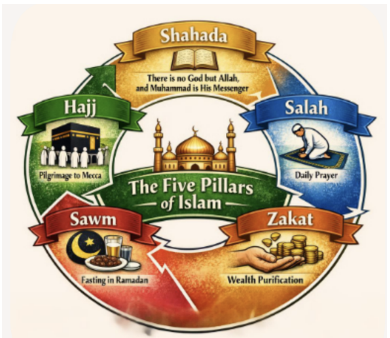
All of Islamic rituals, including Zakat, are directed to (1) acknowledge God’s generous endowment to humanity, (2) build relationship with the Creator through worship and devotion, (3) maintain purity of one’s soul through practice of goodwill and generosity, and (4) fulfill one’s individual and collective role as God’s agent (خَلِيفَةً) on earth by upholding truth and building just societies. Each of the five pillars individually and collectively reinforce these purpose-driven actions and conducts. In that sense they are part of a virtuous circle where parts exist not in isolation but in collaborative reinforcements.
The Qur’an consistently mentions Zakat in parallel with Salat (daily worship) in many verses, though there are very minimal directives given on both Salat and Zakat in the Qur’an itself. To fill in the gap, the Prophetic traditions, instructions and early practices form the basis for Salat as well as Zakat. There is another concept – Sadaqah (ٱلصَّدَقَـٰتُ), voluntary charity, is also mentioned in the Qur’an and my fear is that we have somehow mixed the two as one and the same, with Zakat being the minimum and obligatory part of the broader concept of Sadaqah. Earlier Jurists (فُقَهَاء) had indeed used verse 9:60 to justify that position which I find untenable. Let’s explore this verse:
Charity (ٱلصَّدَقَـٰتُ) should be directed to (1) meet the need of the poor and otherwise needy, (2) bear expenses for those employed to administer the fund, (3) support those whose hearts incline to (faith), (4) (free) people from captivity and debt, (5) support those who strive selflessly in God’s way (learning, educating, struggling, reforming) and (6) help travelers (away from home). This is an ordinance (فَرِيضَةً) from Allah. God is Knowing and Wise!
First and foremost, this verse starts with the word Sadaqah. If it was meant for Zakat, the verse could have easily started with the word Zakat. God certainly knows the difference between Zakat and Sadaqah and if these were (are) the same thing, then why introduce two different terms for the same thing. Qur’an is very precise in its usage of words and terminology. Confusion comes when we begin to lose that distinction or make one term subservient to the other. Assuming this verse is about charity, then the Qur’an provides six different means by which this charity can be fulfilled and be acceptable. An analogy might be the US tax code where to qualify as a for 501c(3) non-profit, you have certain restrictions or qualification with regards to what donation and expenditure is tax deductible and what is not.
Then the word فَرِيضَةً at the end of this verse, which may mean obligatory duty (such as daily prayer), or an ordinance (how to satisfy certain aspects of religious doctrine) or specific allocation or means to fulfill the guidance at hand, caused some interpreters to assume that since obligatory duty is applicable to Zakat while Sadaqah is voluntarily, this verse must talk about Zakat. Another interpretation might be that the word فَرِيضَةً here is to denote the various modalities of Sadaqah and is not related to Zakat at all.
Zakat in Practice
The significance of mentioning Salat and Zakat always in parallel is profoundly significant. God endowed each human with a soul to prove its humanity and allocated a measure of provision to sustain this earthly life. Purity of the soul is achieved through Salat and the purity of the provision is achieved through Zakat. Without a soul we are not human and without provision we are destitutes. Having said that we know that Salat as a marker for faith is necessary but not sufficient to uphold the truth and create just societies. In a similar vein, Zakat is to purify your excess provision that you do not need, but God gave you as a favor and as a trial see what you do with this excess. But Zakat cannot be effective if people’s basic needs are not met and that is where Sadaqah comes in to create the foundation of a minimum equity in society and Zakat should strengthen that foundation by enabling truth and justice, the dual window of progress through which the ray of sustained human development really shines through.
A simple way to distinguish between Sadaqah and Zakat is as follows: a hungry person needs immediate attention for food, health and other basic needs. This calls on any and every Muslim individually and/or collectively to make sure that this person’s immediate needs are taken care of through Sadaqah so that his or her survival, dignity and freewill is not compromised. A larger and more strategic question is – why is this person hungry and destitute? What kind of a society allows such a condition – not a just society for sure? Why would God’s agents not address this challenge pro-actively and strategically so that hunger is eliminated as a social condition and social norm. My humble understanding is that Zakat is that instrument where fund is collected as a community (local, regional, national, global) and the community should deliberate and decide to fund large scale projects focused on the wellbeing of the entire community – be it Education, Skill building, employment, institutions, infrastructure, etc. Such Focus will allow pro-active capacity and capability building to build just society based on truth, patience and empathy. Zakat should strive to enable each member of the community to live a life of self-sufficiency, dignity and freedom to make informed choices about faith, goodness and serving others.
There are many Hadith traditions and practices from the Prophet and early Muslim communities that Zakat was collected by the leaders of the community and put into use based on the collective priorities of their community while Sadaqah was strongly encouraged at the individual level to help others. Prophet used to send people to collect Zakat on fruits, harvest, livestock, personal jewelry and other possessions using a formula of 1/40th (2.5%) of the asset, sometime with minor variations and exemptions. Abu Bakr declared open war with communities that rose up after the death of the Prophet and refused to pay Zakat. This is another credible evidence that Zakat is a collective enterprise by the community and for the benefit of the community and should not be left to individual choices and individual priorities. During Prophet’s time, Zakat was the main source of funding battles since there was no standing army and many of the volunteers lacked fund to find transport, weapons and provision to defend themselves against aggression and undertaking long journeys to limit hostilities to minimum.
Initial focus – Muslims in Western Countries
This article is written from the perspective of a Muslim living in the West where government collect as taxes significant portion of one’s income and use those funds in a transparent way to the wellbeing of society and individuals for education, healthcare, financial security, national defense, enforcing rule of law and supporting civil society within their respective borders. In many of these countries the overall tax on income could range from 20% to 60% depending on income bracket and the nature of commitment society makes for collective wellbeing through the state.
Since Zakat is based on net wealth that is relatively liquid and is under your sole control, and not on income, one could argue that irrespective of what taxes you pay, Zakat obligation, by itself should hold. If you are in a high tax country, your net wealth will be lower and hence your Zakat obligation will be lower and if you are in a low tax country, the wealth will be higher and hence your Zakat obligation will be based on higher baseline wealth.
Wealth now a days is accumulated and hold in many different forms:
· Liquid assets in the forms of cash saving, bank deposits, Jewelry, artwork, furniture
· Homes, buildings, lands unused and lands for cultivation and other income producing usage
· Business that makes products and services holding inventory, bank deposits, equities, etc.
· Stocks, bonds held by individuals or by business on behalf of owners
· Retirement, pension and other forms of retirement deposits and income streams
Zakat is normally assumed at 2.5% of net asset which is the total assets minus all outstanding liabilities. For example, if you have a rental home, the net asset would be your value of the house minus any outstanding mortgage loans on it. If you have asset in public equity (such as stocks and bonds), the asset would be the current market whereas if the stocks are not public and you have no way to liquidate part of it to pay Zakat, then Zakat can be deferred, unless you have other liquid asset sufficient to pay Zakat on your private equity. Zakat would be due on your current asset – bank balance, savings, checking and other deposits (averaged over the last 12 months). If you have substantial savings in the form of 401(k) or other types of retirement fund but you can’t have access to it until you retire and have to take distribution, then the retirement fund would not be zakatable until you reach retirement age and have ready access to the fund under the law of the country where you reside.
Steps in Zakat involve
1. Identification and estimation of Zakatable assets
a. Identifying all assets and liabilities averaged over the last 12 months, including bank deposits, savings, stocks and bonds, rental properties, lands owned and cultivated, Jewelry, art work, etc. In the event of business owners, net asset of the business and allocated ownership (if less than 100%)
b. Identifying liquid and semi-liquid assets from which Zakat should be estimated and paid
c. Identifying other assets that may not be liquid but Zakat should be estimated. Then the challenge becomes if you can’t convert part of the asset to pay for your zakat, do you have other liquid asset sufficient to pay for your zakat, if not estimate should be made and tracking should be in place to account of what was due in the current year and what was paid so that if there is any balance, it can be paid for in subsequent years. Similarly, one could also pay in advance for next year’s Zakat if their liuid assets allows for. (There is hadith reference where Prophet’s Uncle Abbas paid Zakat in advance for current and next year)
2. Ideally Zakat should be collected by organized community-based group(s) who have the confidence of the community and the skills to collect and distribute Zakat
3. Governance of such group should assure community input and periodic prioritization of the focus of Zakat distribution and help identify organizations and institutions that can carry out the mandate of such zakat priorities for the community within as well as across multiple communities, with needs of the local community being satisfied first.
4. Prioritization of Zakat fund investment/distribution:
a. To the extent possible, focus on few (2-3 such priorities) so that significant Zakat fund can be allocated to strategic needs of the community, and
b. Focus on impactful results year after year rather than too many projects with too little funds that fails to demonstrate visible material improvements or impacts
c. Do impact assessments, collect data and revisit prioritization so that Zakat stays relevant to the core purpose – the building and sustaining of a just and equitable society
Below I am giving a simple but practical differentiation of various forms of charity, taxation and donations vs. Zakat
Comparative understanding of Zakat vs. other forms of taxes, donations, and charity
Giving | Amount/calculation/timing | intention | Target receiver | Administration |
Sadaqah | As much as you can afford or willing (not to impoverish) – without regards to income or wealth – as often as you can and want | Serve fellow human being of lesser endowment without demanding/expecting any benefit to givers | Poor, indigent, travelers (foreigner), in pursuit of Islamic goal, ideal as articulated in 9:60 | Individual, family, collective organization (non-profit) Project, program, institution |
Zakat | 2.5% of asset (current asset, fixed asset, business asset, etc.) – once a year (traditionally in and around Ramadan) | Purify and equalize your wealth by giving what is not yours (right passage to wealth – like a toll to travel on a toll road) Acknowledgement that wealth is a gift and not an entitlement Calibrate results and effectiveness | Focus is more on Strategic community priorities/advancement than individual cure/restoration Community wide beneficiaries | Community based (not individual) and as such reflect community priorities and strategies, not individual wishes or whims |
Waqf | Any amount without depriving reasonable inheritance to the heirs – focus on super wealthy (it is a relative term) | Specific cause – mostly singular focus – specific cause, purpose, based on individual wishes | Broad class of beneficiaries focused on specific intent of the giver | Waqf administration or program office |
Tax | Specifics set by governing authority based on legal/governance framework – as a percent of income or sales primarily and sometimes based on inherited wealth, capital gains, etc. | To provide services back to citizens and to support administrative activities of a nation, state and local authorities There is definite expectation of services and benefit in the absence of which legitimate grievance can be brought against the authority | Citizens and residents in the community, country | Governing authority – elected or self-appointed |
Zakat collected by MyLLife is dedicated to several different areas as follows:
· Improve our collective understanding of faith, goodness, truth and justice based on the Qur’an and Hadith and global repository of collective human knowledge. We do so through daily, weekly, monthly, and quarterly conversation, discussions and community building
· Offering Scholarship to college students to pursue education and careers in Public Policy related areas focused on social/economic justice, rule of law and civil society. We wish to increase capacity and intellectual rigor in managing our affairs wherever we might be
· Inspire college students to do impactful research, unconstrained by existing social norms and inspired by faith and goodness in areas of social and economic justice.
Zakat Practiced in Muslim Countries
Our research team will be preparing the best practices from a number of Muslim countries to see how they define Zakat, how Zakat is collected and how it is distributed. We will also look into the transparency, governance and administrative aspect of exercising our collective Zakat obligation, one of five Islamic Pillars of faith (a Way of Life – Deen) around the world.
If you like this article, pls donate to support our work.
(Note: if you wish to contribute to our research on Zakat, pls let us know. We would love to have your involvement and contributions! We will publish our findings in our monthly MyLLife Digest for the balance of 2026-2027)
Rashed Hasan
: Founder & Director, MyLLife Inc., Alexandria, VA
Professor of Practice, Management and Finance, George Mason University, Fairfax, VA
