




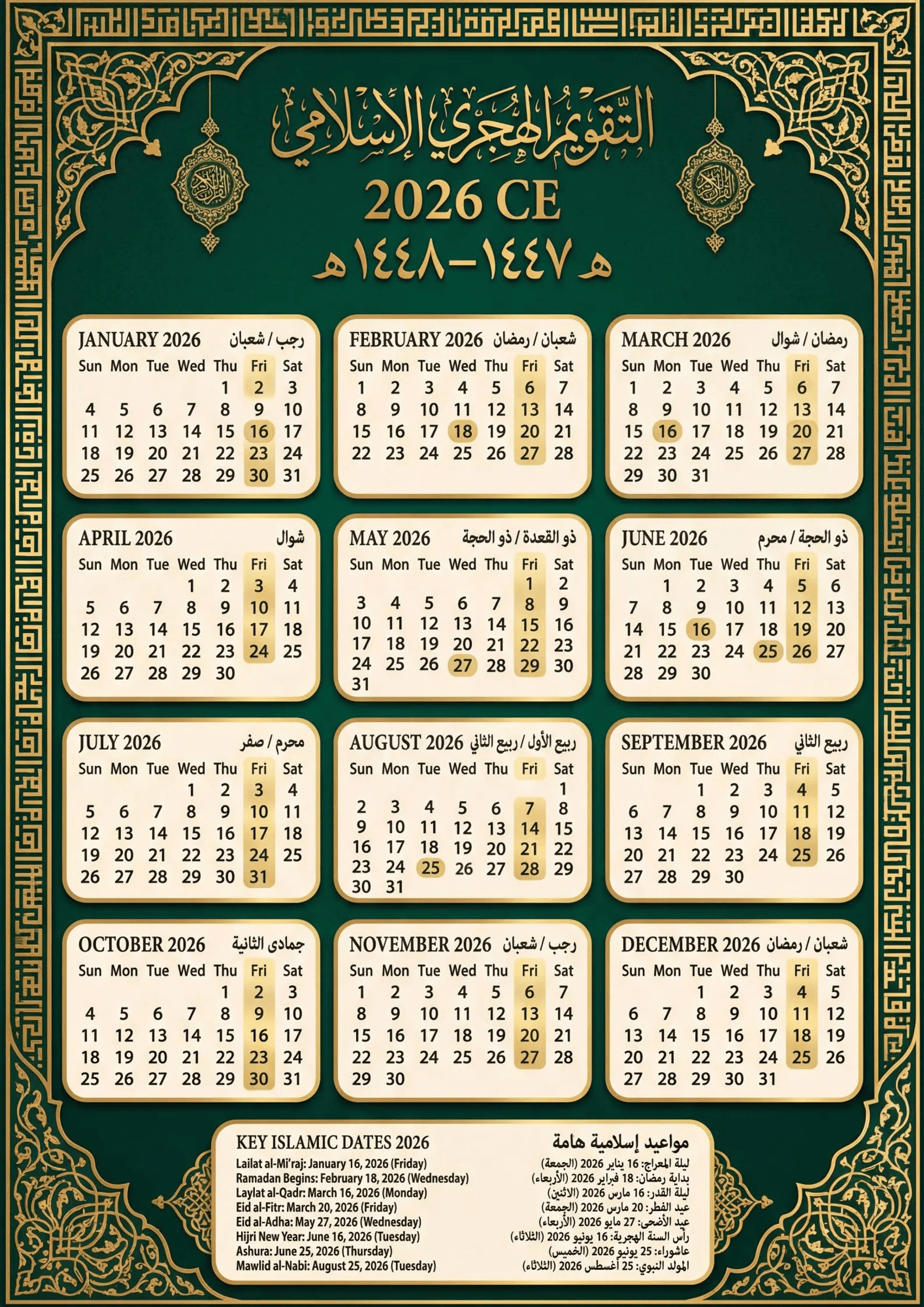
The Islamic calendar is a distinctive way of understanding time. It is rooted in the Hijrah, structured by the moon, and animated by worship. Its months carry memories of sacrifice, fasting, pilgrimage, celebration, and moral reflection. Unlike a purely administrative calendar, the Hijri calendar shapes the spiritual imagination of Muslim communities. It teaches that time is not only measured by clocks and schedules, but also by acts of devotion and moments of remembrance. By returning each year to Muharram, Ramadan, Dhu al-Hijjah, and the other sacred rhythms of the lunar cycle, Muslims are reminded that life itself moves through renewal, discipline, gratitude, and the return to God.
The name “Hijri” comes from the Hijrah, the migration of the Prophet Muhammad and early Muslim community from Makkah to Madinah in 622 CE. This migration was not merely a journey from one city to another; it marked the formation of a distinct Muslim community with its own social, spiritual, and political identity. Later, during the caliphate of Umar ibn al-Khattab, Muslims adopted the Hijrah as the starting point of their calendar. By choosing the Hijrah rather than a birth, a battle, or the beginning of a ruler’s reign, the early Muslims emphasized that Islamic history was rooted in faith, sacrifice, community-building, and obedience to God.
The Islamic calendar is purely lunar. It consists of twelve months, each beginning with the appearance or calculation of the new crescent moon, known as the Hilal. A lunar month is either 29 or 30 days, so a Hijri year usually contains about 354 or 355 days. Since the solar year is approximately 365 days, the Islamic year is about 10 or 11 days shorter than the Gregorian year. As a result, Ramadan, Hajj, and the two Eids occur earlier each year on the Gregorian calendar and in roughly 33 to 36 years eventually pass through all four seasons. For Muslims in different climates, this seasonal movement is meaningful in their acts of devotion.
“They ask you about the crescent moons. Say: They are markers of time for people and for Hajj.” — Qur’an 2:189
This verse links the changing phases of the moon to human timekeeping and to pilgrimage, making it one of the clearest Qur’anic foundations for the Islamic lunar calendar. It shows that the moon is not only a natural sign in the sky, but also a practical guide for worship and communal religious life.
“God is the One Who made the sun a radiant source and the moon a reflected light, with precisely ordained phases, so that you may know the number of years and calculation of time.” — Qur’an 10:5
Alongside Qur’an 2:189, this verse broadens the calendar theme by mentioning both the sun and the moon as signs within an ordered system. The moon’s phases help mark months and years, while the sun’s regular course frames day, night, and seasonal awareness. Together, these verses present timekeeping as part of divine order rather than a merely human invention or cosmic phenomenon.
The twelve months of the Islamic calendar are Muharram, Safar, Rabi al-Awwal, Rabi al-Thani, Jumada al-Awwal, Jumada al-Thani, Rajab, Sha‘ban, Ramadan, Shawwal, Dhu al-Qi‘dah, and Dhu al-Hijjah. Each month carries its own place in Muslim religious memory. For example, Ramadan is the month of fasting and Qur’anic recitation while Dhu al-Hijjah is the month of Hajj and includes Eid al-Adha, commemorating sacrifice, obedience, and submission to God.
Four months are traditionally known as sacred months: Muharram, Rajab, Dhu al-Qi‘dah, and Dhu al-Hijjah. Their sacredness emphasizes restraint, peace, and moral seriousness. In Islamic teaching, the number of months is established as twelve, and the sacred months remind believers that time itself can be honored through ethical conduct.
The calendar therefore does not treat days as empty units; it gives them meaning by connecting them to worship, discipline, memory, and accountability.
If you found this article informative & would like to support further research, click here to donate!
